The Apikores
Gutman Braun2011OpinionReflectionsOff the Derech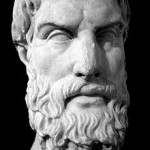 I have never made but one prayer to God, a very short one: ‘O Lord, make my enemies ridiculous.’ And God granted it. -Voltaire
They called me Apikores many times, but I doubt they knew who Apikores was. It’s not that they were wrong about me, except they meant it as an insult when it really wasn’t. Apikores comes from the name Epicurus, a Greek philosopher who maintained that happiness was an emotion worth striving towards. I agree with that. So did our founding fathers; it’s the last of the three unalienable rights in our Declaration of Independence. Epicurus wasn’t a believer in hashgocha pratis – he believed in bechira. He didn’t take a position against belief in God, but he didn’t believe God was involved in our lives.
Paradoxically, I think that those who labeled me an Apikores would generally agree with much of Epicurus’s philosophy. At the core of his thinking was the premise that the highest pleasure — which he defined as tranquility and freedom from fear — was achieved through knowledge, friendship, and by living a virtuous and simple life. He advocated reducing desires, and argued that one should not overindulge in food or sex as these would only lead to dissatisfaction.
So if I am an Apikores, I should act responsibly, avoid overindulgence, live simply, intelligently, fairly and honestly. Epicurus proposed that “it is impossible to live a pleasant life without living wisely and well and justly,” agreeing “neither to harm nor be harmed,” and that “it is impossible to live wisely and well and justly without living a pleasant life.” When I consider his philosophy, I accept that I may be a bit like Epicurus, except he’s a little frummer than I.
So why do religious people use Apikorsus as an insult? Is it because Epicureanism takes things at face value? But when it gets down to it, isn’t that the mainstay of modern day frumkeit?
Even as a yeshiva bochur, I realized that a lot of what we were taught was a list of talking points. Even the teachers didn’t seem to believe them – although many claimed they’d kill or die for them – and the same goes for most of my classmates. Maybe they believed that they should believe them, or that they were true once, somewhere else, at some other time. But more than anything, they didn’t know what else to believe. Sure, sure, Klal Yisroel is genetically superior, “holier”, the kohen is genetically predisposed to peace, Jewish actions are inherently correct, Torah and Mitzvos refine us both spiritually and intellectually. Sure, sure.
But of course, among the people we knew, the kohanim didn’t display any recognizable maylos, and our fellow Yidden didn’t seem to be all that great. Many a frum Yid who went to the mikveh every morning, who went to shul three times a day, who ate food only with the best hechsherim, displayed gaping holes when it came to matters of ethics, morality, or even self-control. We didn’t know many gedoilim that we could really call wise. Clever sometimes, but cleverness is not a legitimate replacement for wisdom. In fact, there was little I could think of that made Jews better than non-Jews. We wouldn’t dare point out the brazen nakedness of the emperor, but most of us knew it to one degree or another.
We recognized, even as children, that Ahavas Yisroel only applied to a certain segment of the population. It was no secret that honesty was a virtue applied selectively. Trivialities, like Kashrus or hilchos Shabbos were kept – a la Epicurus, self-restraint is good for humankind – but those are superficial things that served one’s social needs, providing a sense of identity. Anything significant and meaningful that we were taught, was, for the most part, disregarded.
The vast majority repeated their lines with diligence for years and years, but in their private lives they often ignored the script when it was convenient. I think most of my classmates were pleased by this. It showed there was a way to beat the system and make it to the top without actually having to be a better person. They learned that whenever rules were emphasized, ethics were not. Thus, these rules (like all rules) really provided one with ways to get away with whatever one wanted. To paraphrase Einstein, once you properly learn the rules of the game, you can then figure out how to play better than anyone else.
When I questioned this, when I pointed to our collective flaws, I was asked: “What? Is the rest of the world any better?” And I found that argument, that rhetorical vehemence itself an indictment of it all. “Others do it too,” is the poorest excuse for someone caught with their pants down.
“If one follows our teachings,” they told me, “one can reach lofty heights. Look at the great people we produced!”
“Nu,” I said, “and what about the no-goodniks we produced?”
“They don’t count – they didn’t follow the rules.”
So we take credit for the successes and blame the individuals for the failures. Heads I win, Tails you lose.
“Who do you think you are anyway?” they would ask. “You think you’re smarter than all our great sages?”
They took me to someone else, the “perfect person to speak to,” they said. I was introduced: “Er meint er iz an oifgeklerter.”
“Azoi? So you think you’re so smart that none of your questions can be answered?”
“No,” I replied. “I’m pretty sure anything I’ve thought of has been thought of before – by people who suggested answers as well as by those who did not. My problem is that I see this entire package as a system designed to keep people busy, to preserve the group identity and to maintain a power structure that benefits those who sit at the top.”
“Well,” I was told, “What do you and what don’t you believe?”
And I told him. “I don’t believe that the things that I am being taught are supported by facts on the ground.”
“And you only trust your senses? Don’t you think your eye-sight might be limited?”
“I realize that,” I said, as we concluded the conversation, “but they’re the only eyes I have.”
So they called me an Apikores, unwittingly honoring me with a label of a man most people of true faith would be proud to emulate.
19 Responses
Umein Y’hei Shmei Raabu! I couldn’t have said it any better myself!
religion is a belief not a provable fact. we believe it is a fact but that’s what we believe not a scientific fact. if you belief in the Jewish religion without scientific proof and you still have lots of questions i will be more then happy to answer them or try to. but if you need proof then religion is not for you that’s why our kids start their prayers with shma beni musser avichu ……. because my child this is the only proof that our religion is the right one the fact that your father tells you so and we believe his father told him and his father and so on till when god gave us the Torah Having said all this we have lots and lots and then some more of stupidity corruption evil and all those other stuff but as a religion we are not that bad and we did have lots of wise smart and knowledgeable leaders not many left but to say we had none that’s stupid just ranting a bit writing never is bad questions are never bad so keep on writing asking but be prepared to listen to the answers
Twister:
1) It’s called p-u-n-c-t-u-a-t-i-o-n. Try it.
2) After deciphering your coded message, it seems that you had a problem with a certain word that you say was used. Which sentence are you referring to?
Gutman — Punctuation. Prffppt… Such a goyish concept. The gemara has no punctuation. If that was good enough for Abaya and Rava it should be good enough for the rest of us…
Maybe if we spoke like this it would help the hoi-polloi learn how to use it properly:
http://www.youtube.com/watch?v=lF4qii8S3gw&feature=player_embedded#at=19
When I expressed your ideas, a Rabbi told me that I needed to understand that which I am accused of being. I did, but it didn’t change my ideas.
I guess I, too, am an apikores.
In paragraph 2 you paraphrase Wikipedia [http://en.wikipedia.org/wiki/Epicurus] but don’t quote to the end:
“He taught that pleasure and pain are the measures of what is good and evil, that death is the end of the body and the soul and should therefore not be feared, that the gods do not reward or punish humans, that the universe is infinite and eternal, and that events in the world are ultimately based on the motions and interactions of atoms moving in empty space.”
I think that on the basis of that, many of your frum (former?) friends would go along with defining you as an Apikoros. The Epicurean philosophy as explained there does seem to be pretty similar to modern secularism.
Interestingly [http://en.wikipedia.org/wiki/Epikoros_(Judaism)] explains that the original use of the term was accurate to designate someone who denied providence. However it began to be used widely and indiscriminately as an obfuscation because of Christian censorship.
I figured that instead of answering or thinking about what i am telling you you would say my English vocabulary or p-u-n-c-t-u-a-t-i-o-n. isn’t up to standers. hey i gave it a shot .. as far as for my life with my bad vocabulary and punctuation i still did very good in life and i am very happy and content in life again as i said before questions are good but you you should try sometimes to listen to the answers
Mr Twist,
Punctuation is not some unnecessary secular skill; it’s merely the only way to communicate using the written word. If you want someone to understand what it is that you’re saying, it is really essential that you make an effort. Is that so much to ask?
It’s especially hard to reply intelligently to anything you wrote if I can’t understand it. Perhaps you could try again to explain what you wanted to say, and I’ll try my best to respond accordingly. It seemed to me that you took issue with something that I wrote – can you specify what line it was that you were referring to?
And here I was thinking that Apikorus came from Hefker, I mean that’s what it says in the Artscoll. *ducks*
Here is your problem Gutman.
You want to reply intelligently? that in itself is so fargoyisht! The only thing intelligent, is intelligent design!
of course lol…
I had a similar encounter with a very prominent Rabbi. When I told him that I have sfeykos in Emunah, all he had to say was, “So you think that you are an authority on deciding matters of Emunah! So you think that you’re smarter than Avrohom Avinu!”
I once had a friend who told me go and ask my questions to Rabbi Manis Friedman or Rabbi Immanuel Shochet (two lubavitch rabbis who are considered intellectuals) , SO I smiled and said but do you know the answers, and he said I don’t have the questions , and when/if I do they don’t bother me.
Velvel Belkin; interesting post. It would be most fun to follow through (despite the fact that your friend doesn’t sound too serious..perhaps he is conflating “It doesn’t bother me” with “I don’t think enough to care”) and go ahead, ask those two intellectuals. But if you do, be sure to not back down, just like you continued to press your friend. I am sure the interaction you have will generate an interesting essay. I would look forward to a full account.
Yoel in theory I would love too , but in real life it would not be wise or helpful for me to make a name of myself for being an apikorus/rebeller (I know its not a real word but you get my point), which is actually the reason I use a pseudonym on this site.
Velvel; I hear you! all quite understandable and reasonable. Basically, there is a lack of intellectual discussion. Rationalism should be defined as a feeling of confidence that reason is on your side, therefore you are willing to let the other guy talk, and have an open discussion. (all because you are sure reason will ultimately prevail). That is why I get concerned when the “intellectuals” prevent or deflect open discussion. I have found a lot of teachings that at root are basically arguments to persuade people from having actual conversations with actual experts (experts, in secular knowledge…oh dangerous things like mathematics, or physical science. like why should that be so negative? i would think respect for scholars (all scholars) is important. And even in the Kuzari, the King said one must respect scholars. Now is the King of Kuzaria someone to emulate or not? that too is a worthy discussion. bring that up with some “intellectuals” and see what happens.
but as you way, “in theory” it is good, but in real life… I understand
The problem when they say “You think you’re smarter than Avraham Aveinu, (or Rabbi Akiba or Rambam or whatever godol they follow), is that they self-select from the universe of intelligent people. If you look at it from a different perspective, you’re probably not smarter than Socrates, but that does mean you have to believe in Zeus? You’re probably not smarter than Aquinas but does that mean you have to be a Catholic? You’re probably not smarter than Heisenberg, but does that mean you have to be a Nazi?
Ichabod- Also we follow our own intellect not other peoples . Frankly I don’t care if someone “smarter” (whatever that means”) then me thinks something, if it does not make sense to me, I will not think it , and probably not act on it.
Amen, Reb Velvele!
The entire argument (you should do X because Y is a smart guy and he says it’s a good idea) is so tiring and annoying. Obviously, one of the the easiest ways to slip a stupid idea past the goalie (in this case, your brain) is to say it in the name of someone ostensibly smart…