The Crack in the Western Wall
Samuel Katz2011Reflections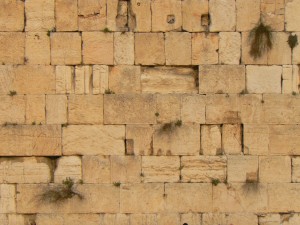
credit: ldjaffe
Every year at Tisha B’av I remember the incident that happened four years ago. It was a Thursday night, I was studying at yeshiva in B’nai B’rak and headed to Jerusalem to visit the Western Wall. The urge was sudden but I didn’t question it. I boarded the bus with my mind set on spending a few hours there, leaning with my face and palm pressed against the Wall. Arriving, I passed through security and hastened my pace. As I got closer something felt wrong. I stopped about ten steps from the Wall. All I needed was ten more steps and I could touch the remnant of our ancient temple. Yet I could not take those ten steps. I stood there for a while, looked around and went back to B’nai B’rak.
I never went to the Wall again.
I remember that incident because it was there that I realized a crucial distinction between religion and secularism, and where I stood in the context of the two. The distance between me and the Wall that night was the distance between me and the religion of my youth, and since then the distance has grown. Every Tisha B’av I am reminded of that.
On Tisha B’av we would fast and sit on the floor and cry. We cried because our temple was destroyed and we cried because God was disappointed in us. Some cry at the Kosel for health and some cry for peace. If you asked my younger self I would tell you that we cried for what we lost. Truth is we never lost anything, and that was the problem.
As I neared the Wall that night I realized that religion, in its extreme form, is the black hole of our cultural cosmos. It loses no claim, no idea from within it. It never suffers the slow progression towards entropy we all must face. You never need to let go of anything if you believe. The Holocaust killed six million Jews but the God of Orthodox Judaism emerged unscathed. His claim of love for his people was not lost. An earthquake can kill thousands, but God’s claim to omnipotence never crumbles. Tsunamis can wash away cities and its inhabitants, but God’s claim to benevolence is never diluted.
To the believer, souls don’t die and evil never triumphs. Everybody who came to that Wall that night, every man and woman I saw crying, did not know how to lose something. They came not because they lost their temple, but because they believed they could never really lose it.
At the end of Eichah, the book we read on Tisha B’av about the temple’s destruction, we say “Return us, God, to you and we shall return, renew our days like in the beginning.” Religion promises you that you can start again, that nothing is ever completely lost. But we can’t. To paraphrase Harold Pinter “We can’t start again, we can only end again, and again. We can end again and again.”
I stood there ten steps away because I, unlike them, actually lost the temple. I lost it and I lost God. Not the kind of loss that promises you will find it again. I lost it for good.
But the people at the Wall knew something I didn’t, and I realize it again with each year that passes. The people at the Wall knew how to cry and I didn’t.
People say that religion is about joy and celebration, but I never believed that. There are plenty of joyous occasions within the secular lifestyle. You don’t need God to say Hallelujah. What religion gives you is a place to cry. There are three times a day that you can cry, there are books you can read that demand that you cry, and there are people to cry with.
I can cry today, but I usually have to do it on my own and it would be followed with shame and the knowledge of its futility. I can find friends or confidants who will let me cry, but they will try to get me to stop, because our secular minds don’t know how and when to cry. Now when I want to cry, I ask myself what good it will do, and I never come up with a good answer.
But in the framework of Orthodox Judaism there is always a place to cry, and that’s its greatest contribution. The place it creates for the cathartic release, where we forgo the advanced articulation of our sorrows and express ourselves in the most primal way.
That night, ten steps from the Kosel, I realized that the men and women around me knew how to cry, but they didn’t know how to lose something. I knew what it is to lose something, but I didn’t know how to cry.
I looked at the Wall that everyone around me was looking at and I knew that they all saw the rocks that survived. I, however, saw the cracks time has made in them, the cracks time has made in everything I knew about that place. I didn’t want to feel the stones, I wanted to feel the cracks.
I am glad that I now know how to lose things. It’s how I know I can gain things. I value my life, because I know that I can die, really, really die. I am excited when I see good, because I know I could have seen evil. I cherish what I have now. But I do wish sometimes that I knew how to cry like those men and women at the Wall, or like I used to on Tisha B’av. But I can’t.
Every Tisha B’av I remember the destruction of the Temple. Not the one that happened two thousand years ago – but the one that was destroyed that night when I stood there and then turned away. It was destroyed for me when I gave up on it, when I gave up on all of it. I remember the cracks, in my mind those cracks had already caused that whole Wall to crumble; time and history does that, it did it to the Wall and it did it to me.
And sometimes I almost cry. Not for what I lost, but for the crying I can no longer do. That’s my catch-22: to cry I had to lose it first, and once I really lost it I could no longer cry for it.
That is the paradox and that is the price.
27 Responses
“I realized that the men and women around me knew how to cry, but they didn’t know how to lose something. I knew what it is to lose something, but I didn’t know how to cry….That’s my catch-22: to cry I had to lose it first, and once I really lost it I could no longer cry for it.”
Brilliant!
A very deep and well written account.
Powerful stuff. Thank you for sharing.
Samuel dear, a beautiful article. However, to my simple ears, it sounded like you were, both, crying and that you never really lost it.
If I went to the Kosel now, I’d probably cry like a baby; I’d cry over my lost belief. Excellent piece!
In 1998, I went to the kotel, fully expecting to burst into tears as soon as I saw it. Didn’t happen. I felt an emotional blankness.
In 2005, I was completely overcome with emotion the moment I stepped into a Jerusalem shul. I walked in out of the sunshine, smirking and joking with my friends, and bam. Instant blubbering.
What kinds of experiences can the folks here relate, specifically in terms of ‘holy’ spaces? Chevron, the Kotel, Auschwitz?
For someone who claims to have lost all faith in the mystical, Mr. Katz seems oddly eager to portray himself as a psychic:
“Everybody who came to that Wall that night, every man and woman I saw crying, did not know how to lose something. They came not because they lost their temple, but because they believed they could never really lose it.”
It’s hard to decide which is more amazing. Mr. Katz’s eerie ability to read the minds and hearts of hundreds of men and women. Or that the content of these hundreds of individual hearts and minds was so utterly facile and trite.
Mr. Katz’s piece doesn’t prove that the price of atheism, or agnosticism, is constipated tear ducts.
Mr. Katz instead demonstrates that his brand of atheism, or agnosticism, results in a desire to use real living-breathing people as a means to an end. To reduce them, in this particular instance, to a convenient rhetorical device for making a rather incoherent point.
In other words, Mr. Katz’s apprehension of those men and women at the Kotel has more logical fallacies than Glen Beck’s politics and theology combined.
Great article! although I never gave a hoot about the Kosel, I can understand the feeling but I will never get the idea of talking to a wall, umm… well… sometimes when I talk to some people and I realize I’m talking to a wall it does make me want to cry.
Hey, Samuel!I just caught the piece by Ari Daniel Shapiro, depicting your new life on All Things Considered. That was serendipitous, reading your piece here and then hearing you speak on NPR. Way to go!
I was actually at the Kotel for the first time this past week. I was expecting this bigger than life experience. I really thought I’ll break down in tears, and my heart will just melt. None of it happened. “You can’t feel it, if you’re not ‘bikedusha'”. Explained my friend that dragged me down there. “Your emotions chokes when it’s so close to the truth, if it’s not pure”. “Can it be that hundred’s-of-thousand’s of people are completely insane?” absolutely! People let their emotions fuck with them, and when it take them to places where sociaty would plead ‘insanity’ for them; they raise the ‘God’ flag, and all must accepted as solid truth…
Sam, thanks for putting me in the mood for Tisha B’Av. I quoted you in a comment I wrote elsewhere about what I will mourn for this year. http://www.unpious.com/2011/07/thou-shall-not-lie/#comment-41862
I listened to your interview on NPR. It sounds like the unbridgeable gap between you and the Wall, between you and the religion of your youth, was born of your upbringing, of your parents’ presentation of Judaism, of the community where you grew up. Your treatment by your Rosh Yeshiva, hanhalah, and peers in that yeshiva in Bnei Brak deepened and widened the break.
But they CREATED the divide between Torah and secularism. They decided that going to college is incompatible with traditional Judaism, that science and Torah are mortal enemies, and that one must choose between secular wisdom and culture and Yehadus. I think I understand why you bought into that – what was your alternative? Did you know that a true Torah lifestyle promotes healthy, productive living? Welcomes goodness and wisdom whatever its source? Does not require living in the 18th century ghetto? No, no one was there to teach you better. And so the gap became a real, forbidding, impassable ocean.
Sam, now you have grown. You have an open mind and a good library. You can think critically. Look at Torah with your new glasses; see if your youthful religion and the world of your Bnei Brak yeshiva is the sole representation, or even a valid representation, of G-d’s word.
You ask good questions. Are they based on correct premises? Are they founded on childish caricatures of G-d, His relationship with the world, and our national character? Within 3000 years of Jewish literature, you may find a G-d, a Torah, and a Jewish people that is compatible with essentially everything you believe is good and moral. Maybe you will see there is no gap, but there is a broad promenade that encompasses both the ground you now stand on and the hallowed ground of Mount Sinai.
And maybe you will even be able to cry again with me. Cry for brothers and sisters oppressed because of misunderstanding and shallowness. Cry for sisters and brothers whose lone escape is to desert our people and our heritage, to defect to causes opposed to our national purpose. And cry because we feel shattered by the seeming impossibility of bridging the enormous psychological, informational chasm between those we love and the good life we wish they could live, love, and advance.
Again, thank you Sam for giving me food for tears and tears for food this Tisha B’Av.
Meh, I don’t really see anyone crying on Tisha B’ av. What I do see is: people feeling guilty for not at all feeling any sadness, people saying kinos and imagining that they’re crying, the moaning and groaning right out of a movie where the acting is an utter flop, and some other more sincere people saying it in a sad sing song, hoping that the chitzoniyos will be me’orer the pnimiyos. But crying? No.
(oh, and there’s nothing like the simcha one feels when a lonely year finally does roil down the cheek, hoping that it wasn’t just caused by dust in the eye…)
On another note, “LeDAAAAtee, leDAAAAtee, toor men nisht gein tzim koisil!”
I cry every tisha ba’av, not for the temple, but for the people who died defending it. I cry not for the god who abandoned us, but for the jews who stood by him screaming shma yisroel as he burned them in gas chambers. and mostly i cry for myself for knowing this now, and loosing my faith in god and his temple. like you wrote Ushi, its lost lost, it will never come back. and if thats not worth crying for, nothing is…
“Now when I want to cry, I ask myself what good it will do, and I never come up with a good answer.”
People (psychologists?) usually say that crying is a form of emotion release. If you don’t think of it as negative and you let it go (if and when it comes), it can definitely be helpful.
As far as crying on Tish’ah Be’av, I have been saying that it is one of the examples that shows how religion controls its followers’ emotions. You HAVE to be sad no matter what.
And to Mr. Der Bik: If he (Samuel Katz) would have come there as a stranger who has never seen this ritual, never came across religious Jews, and makes assessments based on that I could see the legitimacy of your comment. However, the author of this article, who happenned to be an honest and wonderful individual, expressed those opinions based on his lifelong interactions with those individuals (and their likes). While you might object and say that he didn’t interact with those PARTICULAR individuals who were that very evening at the Kotel, in a sense all religious Jews share similar ideals and values, especially when it comes to the subject of the Temple, its destruction, and its mourning; and that’s what those people represent.
@PinnyGold
Hogwash.
I’m not frum, but I’m close to many people who are, and who also daven at the Kotel on Tisha b’Av.
And I know that their thoughts, beliefs, and feelings, about the Kotel in particular, and about Jewish suffering in general, are infinitely subtler, and far more complex, not to mention contingent, than Mr. Katz would have his readers believe.
What I find especially dispiriting is that the same people who would dismiss Orthodox Judaism for being “simplistic” are quite willing to employ simplistic caricatures of Orthodox Jews and their beliefs in order to discredit them.
So much of this carping is painfully unsophisticated.
In my day, buchurim from Bnei Brak weren’t allowed to venture to Jerusalem on their own because there were too many frei Jews and, G-d forbid, Arabs, in the Holy City.
Bnei Brak not only represents an extremely narrow and limited experience of Judaism in general, but an extremely narrow and limited experience of Orthodox Judaism, as well.
Why doesn’t Mr. Katz say what millions of Jews know to be empirically true?
Among the men and women he saw at the Kotel, there were very likely more than just a few who see no conflict whatsoever between Torah and science, or between being an observant Orthodox Jew and being a neurologist or physicist or biologist or astronomer.
Mr. Katz is intellectually dishonest when he claims an omniscience usually assigned only to the G-d he rejects.
I have to agree with “Der Bik on August 8, 2011 at 6:18 pm”. There’s a feeling the author is trying to express, and he seems to be digging and digging, hitting around the area and picking up some other interesting things he finds, but not really explaining what’s bothering him.
@Der Bik:
Thanks for your help. You just helped me explain my point.
Mr. Katz’s generalization is as true and accurate just as much as the following sentence:
“Bnei Brak not only represents an extremely narrow and limited experience of Judaism in general, but an extremely narrow and limited experience of Orthodox Judaism, as well.”
I will now take 2 sentence from your first comment and switch a couple of words:
“It’s hard to decide which is more amazing. Mr. Der Bik’s eerie ability to read the minds and hearts of hundreds of men and women…”
…
“…In other words, Mr. Der Bik’s apprehension of those men and women who live in Bnei Brak has more logical fallacies than Glen Beck’s politics and theology combined.”
P.S. Maybe you have a different definition of “frum,” but I wonder how many “non-frum” Jews know the terms frum, buchurim, frei, Bnei Brak and use “G-D” instead of “God”
PinnyGold says:
“I wonder how many ‘non-frum’ Jews know the terms frum, buchurim, frei, Bnei Brak and use ‘G-D’ instead of ‘God'”
I imagine that most Jews who’ve led a fairly well-integrated Jewish life are familiar with terms like frum, frei, buchurim, etc.
I left frumkeit many, many years ago, yet I still sometimes fall into old reflexes, like “G-d.” (I fast on Yom Kippur and keep Pesach and Rosh HaShannah, not by reflex, but because they are part of who and what I am on a visceral level. And they make me feel connected to people I very much loved, may their memory be always for blessing.)
My personal quirks and failings aside, you still haven’t addressed a number of obvious facts that underscore Mr. Katz’s intellectual dishonesty.
Modern Orthodox Judaism was founded on the very notion of “Torah and Science.”
Yeshayahu Leibowitz, one of the 20th century’s greatest Jewish scholars, articulated a Judaism that not only embraced science, but also purged observance of idolatry and romanticism.
Contrary to what Mr. Katz would have his readers believe, Orthodox Judaism isn’t owned and operated by narrow-minded anti-intellectual nitwits.
No Jew, of course, is obliged to accept Orthodox Judaism. But any Jew who would discredit Orthodox Judaism ought be able to take on its greatest thinkers, such as Leibowitz, and give a cogent account of precisely where they were wrong.
Leibowitz is no lightweight. And his apprehension of Judaism, like that of Rabbi Joseph B. Soloveitchik, is so uncompromisingly stark and clear that it’ll give just about any smartypants a good run for his or her money.
Der Bik — I can appreciate some of the points you make. You are correct that Sam appears to take for granted that when he speaks of a religious worldview, his readers will understand that he means (for the most part) a Charedi worldview — or perhaps even a less reflective Modern Orthodoxy. He does indeed — by omission if not by stating so explicitly — give short shrift to more nuanced religious thinkers. (And in that respect, I’m surprised you make your points only in reference to Orthodox Judaism, when your criticisms can apply just as well to Sam’s implied dismissal of non-Orthodox religiosity.)
But be that as it may, I don’t see intellectual dishonesty. I see, at most, inaccuracy in defining his terms. As I see it, Sam speaks of those who have rather simplistic views about their own dogmas and worldviews. If I understand your points here, you would be perfectly satisfied if only Sam were to replace each mention of “religion” or “Orthodox Judaism” with the words “Charedi Judaism.” But if that’s the case, then your objections are mere quibbles.
I’m not sure what it is, but from your first comment here it seems as if you have an ax to grind of some sort. Perhaps you don’t like rhetorical devices, maybe you have a general distaste for artifice. (If so, I suppose then you abhor any form of Midrash — or any typical rabbi’s sermon for that matter.) That’s fine, but it hardly makes the stated point “incoherent,” and certainly doesn’t warrants wholesale dismissal — not to mention a rather mean-spirited tone that gets oddly personal at times — just because you don’t like the style. What seems more likely is that you dislike a more specific aspect of Sam’s worldview, but you don’t care to address it, preferring backhanded comments about his “eerie psychic ability” and cutesy nonsense like comparisons to Glenn Beck. Rhetorical devices, anyone?
Dovid Levine,
” But they CREATED the divide between Torah and secularism. They decided that going to college is incompatible with traditional Judaism, that science and Torah are mortal enemies, and that one must choose between secular wisdom and culture and Yehadus. I think I understand why you bought into that – what was your alternative? Did you know that a true Torah lifestyle promotes healthy, productive living?”
Dovid, I’m just curious. I don’t know the names of the the people involved and probably you don’t either, but if you WOULD know them, and if those people are or operate under the guidance of “Torah True Judaism” and “the Gedolei Hador”, would you be willing to publicly repudiate them by name? Are you willing to stand up and say they are wrong? Would you stop supporting their moisdos and charities? Or are you grasping at straws, pulling out the “Eilu V’eilu” to try to save a soul with whatever rhetoric is available to you?
Thanks for your question, Baal Habos.
I don’t know who they are. I am trying to imagine, though, if I would know who they are, would I confront them publicly? And would I forthrightly mention them by name here in this forum and say I think they are wrong?
I don’t think so. For the same reason I wrote respectfully and with a conciliatory tone to Sam (and Shira and Leah in the other comments I wrote). My objective is to build, not to tear down. I do not presume to be a judge to Sam, nor am I the arbiter for people on the other side of the fence. If I had the opportunity to get to know them and to have them get to know me, I think I would see if it would be productive to present my view to them. If they had an open forum on line like this one, and it was proper etiquette to post thought-provoking comments to them and their readers, I might comment there too, assuming the comment would be taken graciously. I hope I would not be contemptuous or hostile in any case.
Also, while I believe normative Chareidi Judaism’s method is untenable for many of our people, I do not want uproot that society. And I wonder if the members of this forum would agree with that (there would be much less good writing material, too, if all “Torah True Judaism” fell to the wayside ). Indeed, I admire and cherish many aspects of that society, and I respect many of its members. For many Jews, an insular, dogmatic approach works best, and exposing them to secular culture and open inquiry would do much more harm than good. I understand why Sam’s experiences in Bnei Brak would result in him rejecting that form of Judaism. I don’t know the relevant details, but I think I would support a more nuanced approach in my yeshiva. At the same time, I hope Sam can see why for Bnei Brak Jews, taking the extreme approach might make sense. His Rosh Yeshiva probably was not malicious; he was trying to protect his charges and act responsibly. I would not condemn the Rosh Yeshiva because these are rarely cases of clear-cut, objective right and wrong. There are no neat, perfect solutions for complex, tangled problems.
I am not trying to save a soul; I am presenting a challenge to build our people. I believe the underlying theme of the Torah is personal and national health and success. I think this is borne out by much Jewish literature. I am asking Sam, Shira, and others who come here: Why concede a monopoly on G-d and His Torah to those whose approach is antithetical to your principles of living? Clear your mind of the fog of your yeshiva education. See if you can find a broader approach to genuine Torah living that encompasses a weltanschauung that is faithful to our tradition and ideal for the (growing) slice of our people who can’t live healthy, productive lives in the existing atmosphere. I think in 100 years from now, the face of Judaism will be drastically different one way or another. Your sincere, respectful contribution could crystallize changes that rejuvenate and invigorate our nation.
Baal Habos, I am curious too. If you knew who was involved, would you renounce him by name? Would you confront him publicly? And, most importantly to me, if you were stuck together for a weekend, just you and him, what might happen? What would you hope to achieve and how do you think you would be most successful?
Dovid
Dovid,
You wrote very nicely, but I am not sure what changes you are proposing specifically. Which aspects of secular culture are can we embrace (without it negatively affecting us) and which aspects of secular culture should we eschew? A more nuanced approach certainly sounds nice, but i think that both the extreme approach and the nuanced approach involve risk.
Hi Leah,
Sorry, I was not around here for a while. As they say in yeshiva, you are asking good. I don’t know if this is the best forum or medium to share ideas on developing a healthier Judaism. And I am not wise or knowledgeable enough to answer most of the questions. Three points:
1- Honestly, openly, and respectfully revisit Torah. I suggested elsewhere that a good starting point is the writings of Rav Shamshon Rifael Hirsch. http://www.unpious.com/2011/07/thou-shall-not-lie/#comment-48985
2- Honestly, openly, and humbly revisit your own ideas. Know your biases.
3- Try to make choices that promote healthy, growing living for yourself and for our people. Some choices are best for you but impact others negatively, and others are great for national good but stifle individual progress. What is the high road? One that harmonizes your own good with the benefit of others. (My understanding of Avos 2:1)
I’d love to hear what you come up with!
Dovid
hi, dovid – it seems from your writing that you grew up in an orthodox home but without the restictions of chasidishe-yeshivisha. let me educate you a little about the chasidik world. the principle of the hassidik philosophy (if there is any) is, don’t follow what you see in the torah, just imitate your parents and rebbes, they will tell you how to interpret the torah, and if you chalenge the chasiddic ideas, you are labeled as ‘er glitcht zich’. therefore, its very understandable that when they grow up and start to question the basics of chassidic principles, it does not end there. while i don’t think that leaving the torah way is apropriate and i don’t justify it, it is still very hard to maintain a true torah observence when you drifted away from the hassidik values. what you say about knowing your ideas and what’s healthy for you, let me ask you, what if he believes in evolotion and that it would be healthier for him not to have the pressure of keeping shabbos, (which i guess is the case with sam and his peers) should he still not do so? why?
again, i don’t justify their actions, i am just wondering what the rambam would answer on that question
As they say in Skver, the Shulchan Aruch is only for geirim and baalei tshuvah who don’t have a mesorah.
Hi “Siyum” – I think you explain precisely why so many members of this site come from Chassidish backgrounds. My proposal is that leaving your parent’s path does not necessitate leaving God and Torah. People on this site seem intelligent, creative, bold, and in some ways brutally honest. It makes sense that good candidates to blaze a “refreshingly traditional” approach might come from this population.
I don’t think the Rambam would hold evolution itself is a religious question. He would not accept completely random evolution because it denies God, not because it contradicts the first chapter of Bereishis. See Morah Nevichim 2:25 http://press.tau.ac.il/perplexed/chapters/chap_2_25.htm. Theistic evolution should not pose any problem, even with no intervention after Causa Prima.
Keep in mind the Rambam held that for aggada (parts of the Torah not relevant to practice), there is no p’sak. Pirush Hamishna Sanhedrin 10:3 (I think). Since Darwin, there have been many respectable authorities who accepted evolution, such as the Tiferes Yisroel in Derush Ohr HaChaim (end of seder Nezikin, removed in some additions), Rav Hirsch http://www.simpletoremember.com/vitals/Rabbi_Samson_Rafael_Hirsch_Evolution.htm, Rav Kook http://www.scribd.com/doc/36023329/Kook-Nevuchai-Hador, and Rav Gedalya Nadel http://www.zootorah.com/controversy/GedaliahNadel.pdf. If you research the issue and decide evolution is the way to go, you are on solid ground.
(It bothers me deeply that well-meaning people created a fourteenth Ani Maamin, that evolution in any form is false. To me it seems some of them sound like aggadic literalists who make our people look like fools http://yediah.blogspot.com/2008/01/foolishness-of-literalists-rambam-on.html. We have better ways to use our energies.)
Shabbos is vital for the continuity of our people and for an individual’s capacity to live a good Jewish life (of course, accepting that depends on your definition of “truly good” :-)). Remember, the mitzvos protect national and religious order and promote positive living. I can’t effectively express why Shabbos is essential for Jewish national and religious success, and for my own progress, in a web post. It is not difficult to see, though, Shabbos’s contribution to Judaism’s purpose. For some thoughtful comments on the subject see http://books.google.com/books?id=q02JxKxj5jQC&printsec=frontcover#v=onepage&q&f=false pages 151-155. It gave me a better appreciation of Shabbos!
What if Shabbos is great for my people but bad for me? Generally, national survival (common good) takes precedence over individual needs (individual rights). That principle underlies many secular laws and policies. (I think the crux of many conservative-liberal debates is how far to take that priciple). Ultimately, the public good IS the greater individual good. Shabbos is “good for the Jews”, and I would take part regardless of personal considerations. My best interest is to be part of a functioning, successful nation.
“Kafhakela” – I thought the aphorism should be reversed. Minhog avoisaini is for the unlettered; those who can learn should find out for themselves!
Dovid
dovid- regarding what you point out about evolution, to start a debate on this subject would require endless hours of philosoping and this is certainly not the place for this kind of arguing. but let me rephrase the point i mentioned before. the torah is based on the mesohra. period. for if not, we would all make our own calculations whether this part of the torah is in accordence with science or that mitzvah is healthy for the individual or for the public. now, after you acknowledge that the torah is true because of the mesorah, you can interpret it according to your logic, or, todays days, mostly according to the logic of the chachomim z”l. but unfortunately, the chasidim abused the mesorah, and they use it for their own benefit. (think of the reaction of a chasidic father when his son wears jeans and a cap- a chassidic mesohra and his reaction when his son picks the bones from his fish on shabbos- a deoiraysa), therefore, when the kid grows up and he comes to the realization that he was fooled and lied, why should he still beleive in the mesorah? and when he no more believes in the mesohra, the whole foundation of the torah crumbles under his feet, and he will look like the christians, twisting the bible according to his needs and logic, and his understanding of what is healthy and what not, untill he drops it, ones and for all. here you go, sam.