It’s All Kosher (No. 8): Saying Goodbye
The Unpious Posek2011The Unpious Posek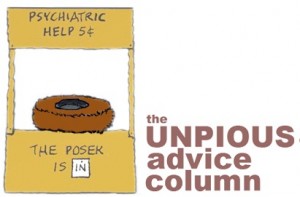 Dear Posek,
I consider myself a well-adjusted OTD. I have a good job, a college degree, and an amazing girlfriend whom I adore and hope to marry one day. I don’t think about my frum past often, but I found out that my mother is ill with a terminal illness. She refused to talk to me for the first few years after I left yeshiva. We later tried to reconnect but our relationship never recovered. I hardly ever visit her. Now she’s dying. I’m tormented by guilt and painful memories. Do I let myself get sucked back into the trauma and get involved during her final weeks/months or do I block it out of my mind?
Distraught Son
Dear Distraught Son,
Final goodbyes are always very painful, but for you, Distraught Son, these feelings are complicated by the fact that you lost your mother a long time ago. You will once again confront the pain of having been a virtual orphan all your independent life. Maybe you’ll feel guilt that somehow your mother’s failing health is the result of the way you live your life. Your mother’s departure can bring up anger, sadness and longing. The grief will present itself regardless of what you decide to do during her final days. You can’t distract yourself to make the pain go away. Blocking your estranged mother’s impending death out of your mind cannot be entirely effective, nor helpful to your emotional health and will not allow you to experience any real closure to this relationship. Instead, arm yourself with support by talking to a professional, to your partner and other close friends in your life when confronting this deeply painful relationship.
I urge you to find the strength to see your mother, but if that will put you at risk emotionally, do it over the phone. If you can muster the strength, pay her a visit and sit by her bedside for your final goodbyes. Prepare ahead by thinking about the last message you have for your mother. Consider carefully what you feel you need to say before she dies. This is not an opportunity to unleash your pain and rage. Say what you need to say without getting involved in confrontations, arguments, or dramatic reunions. This is about paying respect and finding closure. It’s certainly not an opportunity to give your relationship with your Hasidic parent another look. Unfortunately, it is too late for that, and not because of any wrongdoing on your part.
Throughout this process remember that you did not cause your mother’s pain. There is nothing you can do to make her frail body be any healthier. The pain she experienced because of her own choices is not your fault. Don’t allow the mantras you were taught in your youth about children’s responsibility to parents drive you to self-reproach and guilt. The health of a parent is often the most powerful pull the communities have on its children. Very frequently, parents claim they can’t “bear it any longer,” or they “will have a heart attack” if the child leaves yiddishkeit. Your situation can evoke in you these strong feelings.
You made your choice to do what was right for you. No one would have benefited if you would have continued to sacrifice for her. She would in all likelihood still be dying.
I extend my deepest sympathies. May you find comfort and healing throughout this difficult time.
Good luck,
Posek
The Unpious Posek welcomes your queries on all matters of impiety. Send your questions to posek@unpious.com.
4 Responses
What a stupid answer. Why do you think she’s about to die, because she ate too many latkas? Man up to the fact that sometimes choosing your own independence will often hurt others. And that ‘others’ will probably be your mother.
This is a poor answer.
The right answer is: man up and spend as much time as you can with her before she dies. Draw on your own inner kindness and goodness to be kind and good and generous to her. This is to your own long-term benefit as well as to be a comfort to her in the short term.
If you do everything you can today to be a good son – that is, to visit her, to comfort her, to be adult about it – you will have no regrets in the future. If you don’t, you may well be plagued by regret. Treat her as you would wish to be treated. Be a mensch. This will show that you truly are independent.
Crown Hts Mama is right.
Your mother’s death is NOT a story about YOU.
And for however difficult her dying may be for YOU, believe me, it’s infinitely more difficult for HER because SHE’S THE ONE WHO’S DYING.
In this life, being a decent person, by any religious or secular measure, requires us to do things that WILL cause us to suffer. That is simply the way things are. There is no other choice.
Remember, when thinking about what you will and will no do in this situation, you are deciding not only for the person you are today, but also for the person you will be in the future.
As Crown Hts Mama said, you do not want to live the rest of your life with regret.
You have only one mother. She is going to die only once. You won’t have another opportunity to try your best to behave decently and responsibly to your dying mother.
Maybe what you truly fear isn’t the distance between you and your mother and the pain that’s been caused by that. Maybe what you fear is realizing how much you love your mother, in spite of everything.
Losing our parents to death is one of the most difficult things to endure in this life.
Don’t make it more difficult for yourself.
May G-d grant you strength, wisdom, and patience.
Dear Distraught Son,
It’s a very emotionally challenging situation. On one hand, you finally got settled into the lifestyle you’re comfortable with, but on the other hand, you’re risking carrying the guilt of not being with your dying mother for the rest of your life. Yet mustering the strength to spend time with your mother while she’s detesting your lifestyle choice can be nerve wrecking.
So my suggestion is — and this will make her feel at ease and you comfortable around her — pretend you’re somewhat religious. Show up with a kipah, or better yet a tzitzit (with a few strands “accidentally” hanging out of your pants). It will probably make you feel like a fake, but it’s still better than the tension that would otherwise be in the room when you’re present.