Seventeen Days
Esther Levinsky2011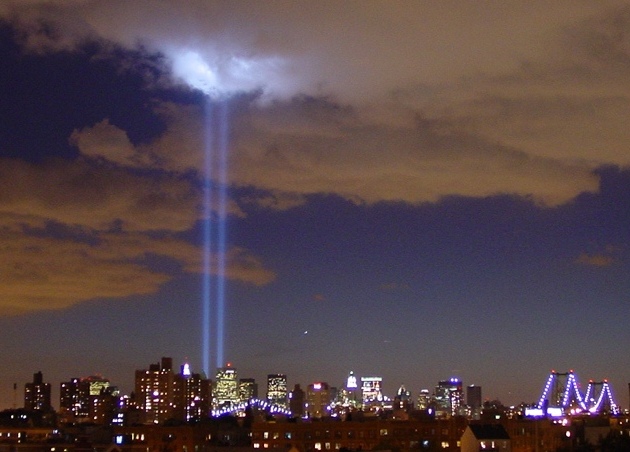
Credit: Alienswede
Yom Kippur, 5762. I clutched a machzor to my chest, mouthing the words of mussaf, eyes scrunched tight as I waited for the end of the world.
Seventeen days earlier, twenty terrorists had hijacked and crashed four planes, killing over five thousand people and eventually sparking two major wars. In Chumash class, the Thursday after the attacks, our teacher began the lesson with an announcement.
“I have something very important to tell you, girls,” he said. “Many years ago, right before the passing of the great Baba Sali, he left an envelope with instructions that the envelope should not be opened until the big towers fall.”
A shudder ran through my body as he paused to let his words sink in.
“No one understood these cryptic instructions at the time,” he continued. “But after the attacks on Tuesday, it was decided that the envelope should be opened. The letter inside the envelope said, ‘Seventeen days after the towers fall, moshiach will come.’”
My jaw dropped.
“Seventeen days after September eleventh is this Yom Kippur.” His cautionary words, that like any ketz predicted in the past, this prophecy may not come trued if klal yisrael was not worthy, were lost in the rustle of gasps and whispers that spread through the room.
We were all in shock. Even the “modern” girls in the class wanted to say tehillim and do teshuva. We spent the rest of the day discussing the upcoming redemption. Why should we do our English homework when we could be saying tehillim instead? What would the geulah be like? Would we be transported to Israel on actual eagles’ wings or via airplane?
Finally, it was Yom Kippur, and the moments were ticking by. For a moment, I thought that I heard a shofar blast. Was that the trumpet that would usher in the geulah? No, the sound was just a figment of my imagination. Mincha ended. Neilah began. Then maariv. No sign of a redeemer.
I remembered my teacher’s words—that it was just a ketz like any other, but still, when night fell without the messiah’s triumphant appearance, I lost a little of my innocent yearning. I became like every other frum person, paying lip service to the concept of moshiach but not really believing in his imminent arrival.
Ten years passed. On the anniversary of 9/11, I think back to the desperate focus I had as a teenager, waiting for moshiach. Perhaps the lesson of 9/11 is the one that I learned that Yom Kippur: no messiah is coming to rescue us. Life is precious and precarious. Rather than focusing on a possible olam haba, I should focus on living the best life possible in olam hazeh. Perhaps that will be my redemption.
75 Responses
The site counted 82 responses; 75 survive in the archived copies.
Well put! May I add the well-known Talmudic dictum: “אין הספק מוציא מדי הודאי” – any doubtful event/claim will never override a certain one. We all know with certainty that Olam Hazeh is a reality that we live every day, but Olam Habo? Who knows? It’s just a big doubt. We must never eliminate/override/give up this world for a “possible” unknown in the next…
Great piece. It is the cumulation of these sort of experiences that eventually sows skepticism into even the most naively faithful. But as you say, most still end up paying lip service.
‘We condemn those who predict the precise due date when moshiach is about to come, for when he does not appear, they say, he will never come’ (Talmud Sanhedrin 97b)
The fact that this kind of superstitious crap was taught, much less believed, is a damning indictment of what passes for education among the frum.
How sad. We must grow up, rid ourselves of the unfortunate legacy left to us by ancestors who picked up superstitions from illiterate neighbors, and once again become a wise, understanding people.
I tell my children Moshiach may well not come in their lifetime. I asked them to pass on to their children that if Moshiach does not come by the “magical” year 6000 they should continue living the best Jewish life they can. I can only imagine the hoopla before Rosh Hashana 5999, and the crushed reaction of the masses if the redemption does not occur. Esther, you will have much company then. I hope my grandchildren get my message and don’t buy into the hype. Listen to http://www.matityahu.org/RavLeffQA/viewquestions.asp?viewcat=3&page=1 fifth question down.
That said, Esther, you see redemption before you. I don’t mean a man on a donkey, fire and brimstone for the wicked and rivers of luxuriant myrrh for the righteous, revelation and a fiery temple descending from on high. I don’t know if those are part of redemption. I mean a world seemingly in the inexorable pull of some force, drawn toward enlightenment and improvement. The fall of the Soviet Union, the Arab Spring, improved health care, increased life expectancy and lower infant mortality…Do you know that efforts by the Gates Foundation cut malaria deaths among children in parts of Africa IN HALF? http://www.gatesfoundation.org/topics/Pages/malaria.aspx Public education, women’s rights, micro-lending in third-world countries, tolerance, multiculturalism, technology, and much more are exploding all around us.
The Torah does not command one to believe mystical instructions left in an envelope. Or even to accept said envelope’s existence. The Torah foretells redemption. Redemption is not a promise of Jewish Supremacy. It is the drive to tikkun olam, world improvement. World events point me towards accepting that prophecy. I know we still have a long way to go, but the world is clearly moving forward. The Jews have an important role to play in redemption, if they are willing to shoulder the responsibility. But I don’t think it is a “Jewish” redemption; God “wants” all creation to be rectified.
Esther, can you find it in your heart to forgive your teacher’s immaturity and irresponsibility? Can you find the courage to explore these ideas on your own? Why should you reject the Torah of truth because someone attached fairy tales to it? Rather, use that experience to guide you, so you will never again place your faith in letters, dreams, mediums, signs, and fortunetellers. Instead, learn the Torah yourself, evaluate the commentaries, explore the teachings of hundreds of generations. Do this with intelligence, honesty, courage, and respect, and you may find an new-old, “innovatively traditional” legacy to pass on to your children and students. They will not be disappointed when fortune cookie messages don’t materialize. They will know better than you did how to distinguish between truth and distortion, fact and wishful fantasy, Toras Emes and dimyon (fantasy). And we will be one step further along the road to redemption!
Unpious Staff- Can you please fix the name at the top? Thanks
Todd- Keep in mind that this happened in the immediate post-9/11 environment. I somewhow doubt that as many people would have believed it if it had occured during peaceful times.
Dovid-
Where do I begin with this one?
1. I did not reject Torah on the basis of this event. This event occured ten years ago, and I only stopped being frum within the past year. However, this event did affect my perspective on moshiach. While I would never have admitted that I did not think moshiach would come within my lifetime, I didn’t really think that he would. It seemed impossible to live everyday believing that moshiach would come in the near future.
2. What is your basis for saying that the geulah is intended as a general improvement in world conditions rather than a redemption started by a man (moshiach) complete with nissim such as techiyas hameisim? What is the source for the redemption being for the entire world’s benefit rather than being focused on klal Yisrael?
3. Belief in Torah most definitely does involve belief in the supernatural. Even if you can prove that Moshiach’s coming will be an exclusively natural process, does belief in Torah not require belief in the makkos, yetzias mitzraim, and divine revelation of the Torah to the entire nation? How are any of these more logical than the “supernatural version” of moshiach?
Dovid – I disagree with your definition of the redemption. Recent events are indeed extraordinary, but they are far from redemption. If you take a look in the rambam (last chapter of mlochim) you wil see that when moshiach will come there will be no fights, no stealing, no jealousy, and no immorality, and the entire world will acknowledge the existence of the one and only god, and the credibility of the jewish (orthodox) religion, and that as long as he does not build the holy temple he is not confirmed as the moshiach. And yes, rashi and tosfos (sukka 41a) say explicitly that the temple will come down straight from heaven in the time of the redemption. This is what the redemption is all about, and as far as I know, the immorality, atheism, stealing and jealousy have only increased since the 1960’s. it doesn’t mean that the redemption will never come, it means that we have not witnessed it so far.
Is it me or the details are not that correct?
Terrorist killed over five thousand people on 9/11???
Are we counting the soldiers who were consequently killed?
(I can’t escape noticing trivial details, sorry)
And while I’m at it:
@Dovid Levine:
“Why should you reject the Torah of truth because someone attached fairy tales to it?”
Which part of the Torah does NOT have some fairy tales attached to it?
Hi Esther,
Thanks for taking the time to reply.
1) It’s impossible and illogical for me to believe Moshiach will come every day, so I don’t. I think this is a myth fostered in yeshivos and Bais Yaakovs. Achakeh lo b’chol yom sheyavo is not in the original words of the Rambam. (I am not even sure what it means – I wait for him to come each day, i.e. that he should come today, or, more logically and likely, I wait every day for him to come, whenever he may come.) The Rambam (introduction to perek Chelek) just says, “Don’t assume he will be long in coming, and if he tarries, wait for him. DON’T GIVE HIM ANY SET TIME”. That means DON’T say he will come today. Many people give up hope because of they hold that false belief. A good analogy is, if you are stuck on a desert island, never give up hope of being saved and turn off your beacon signal, because someone might come to the area any time. At the same time, live your life there, build a house, plant, prepare for your future there. Similarly, I believe the redemption could come anytime, but might not come for a long time.
During the incident of the false Moshiach Bar Korchba, one of the tannayim told Rabbi Akiva “grass will grow over your grave before Moshiach comes.” Obviously, that tanna was not assuming Moshiach would come every day.
2) Moshiach is a human being who will eventually die and his son will take over his position (Rambam on Sanhedrin 10:1). That person will be instrumental in bringing about universal improvement. Moshiach will be an incredible genius and political leader. He will use his talents “to precipitate a worldwide revolution which will bring perfect social justice to humanity, and influence all men to serve God with a pure heart” (paraphrased from Handbook of Jewish Thought II 25:4, by Rabbi Aryeh Kaplan).
See the Rambam that Siyum Hashas quotes in his comment, Melochim 12:1.
אל יעלה על הלב שבימות המשיח, ייבטל דבר ממנהגו של עולם, או יהיה שם חידוש במעשה בראשית; אלא עולם כמנהגו הולך. וזה שנאמר בישעיה “וגר זאב עם כבש, ונמר עם גדי ירבץ” (ישעיהו יא,ו), משל וחידה. עניין הדבר–שיהיו ישראל יושבין לבטח עם רשעי העולם, המשולים בזאב ונמר: שנאמר “זאב ערבות ישודדם–נמר שוקד על עריהם” (ירמיהו ה,ו). ויחזרו כולם לדת האמת, ולא יגזולו ולא ישחיתו, אלא יאכלו דבר המותר בנחת כישראל
In short: During the times of Moshiach, the whole world will live in peaceful, lawful harmony.
At the end of that perek:
ובאותו הזמן, לא יהיה שם לא רעב ולא מלחמה ולא קנאה ותחרות–שהטובה תהיה מושפעת הרבה, וכל המעדנים מצויין כעפר. ולא יהיה עסק כל העולם, אלא לדעת את ה’ בלבד. ולפיכך יהיו חכמים גדולים, ויודעים דברים הסתומים העמוקים; וישיגו דעת בוראם כפי כוח האדם, שנאמר “כי מלאה הארץ, דעה את ה’, כמים, לים מכסים”
Jealousy and competition will cease, and people will seek true knowledge.
Perhaps you should research for yourself, study this with a new, open eye, without your youthful biases. You might decide the burden of proof rests with claimants that Moshiach is solely for Jews. Read the prophecies of Moshiach’s times with the classical commentaries and decide for yourself. “In days to come, the Mount of God’s Temple will stand firm…All nations will stream to it…Nations will no longer take up weapons against each other; they will no longer learn war.” (Yeshaya 2:2-4) “…I will transform the tongues of the nations into a clear tongue…and they will serve Him in unison…” “Sharing a common language will promote international consensus on religious issues…” (Tzephania 3:9 with Metzudos).
“He will strike the world with the rod of his mouth, and with the breath of his lips he will slay the wicked one.” (Yeshaya 11:4) According to Rabbi Samson Raphael Hirsch, this verse reveals that the power of the Moshiach will come from “the rod of his mouth” – the strength of his teachings. Through these teachings, explains Rabbi Hirsch, the conscience and power of goodness within the wicked one will be awakened; thus, “the wicked one has certainly been killed, but in his place, a fresh pure human being has arisen anew.” (Commentary on the Haftoroth) (from http://www.shemayisrael.com/publicat/hazon/tzedaka/mother.htm)
In the Nineteen Letters http://books.google.com/books?id=q02JxKxj5jQC&printsec=frontcover#v=onepage&q&f=false, page 69, Rav Hirsch calls Moshiach’s times “the age of universal brotherhood”, and on page 157 even indicates that intermarriage will be permitted then!
3) I am not saying there won’t be supernatural events in the times of Moshiach. I see no reason to say there will be, since the Rambam in Hichos Melachim and on Sanhedrin 10:1 says clearly the world will remain the same.
אל יעלה על דעתך שהמלך המשיח, צריך לעשות אותות ומופתים, ומחדש דברים בעולם, או מחייה מתים, וכיוצא בדברים אלו שהטיפשים אומרים; אין הדבר כן–שהרי רבי עקיבה חכם גדול מחכמי משנה היה, והוא היה נושא כליו של בן כוזבא המלך, והוא היה אומר עליו, שהוא המלך המשיח. ודימה הוא וכל חכמי דורו שהוא המלך המשיח, עד שנהרג בעוונות; כיון שנהרג, נודע שאינו משיח, ולא שאלו ממנו חכמים, לא אות ולא מופת.
(Melachim 10:6) Moshiach does not need to perform miracles fools claim he will do. Rabbi Akiva accepted Bar Koziba as Moshiach without miraculous proofs.
I had a different point. I said we should not swallow the hokes-pocus people feed us nowadays, which leads us to doubt the real truths of the Torah.
The Torah does describe supernatural events. Those were singularities. God does not change the laws of nature too often, so no reason to assume he will change them with impunity when Moshiach comes. The Rambam even brings in Moreh Nevuchim 2:29 that all miracles were natural, albeit highly unusual, events. “Our Sages, however, said very strange things as regards miracles: they are found in Bereshit Rabba, and in Midrash Koheleth, namely, that the miracles are to some extent also natural: for they say, when God created the Universe with its present physical properties, He made it part of these properties, that they should produce certain miracles at certain times, and the sign of a prophet consisted in the fact that God told him to declare when a certain thing will take place, but the thing itself was effected according to the fixed laws of Nature.” (From http://en.wikisource.org/wiki/The_Guide_for_the_Perplexed_%28Friedlander%29/Part_II/Chapters#CHAPTER_XXIX) It is not clear if the Rambam holds like this (see Tosefos Yom Tov to Avos 5:6), but there skeptics may choose to follow the Medrash.
Again, I wasn’t stressing that Moshiach’s times will be natural. Don’t get me wrong; miraculous predictions don’t stretch my credulity. If one believes in God, miracles are a “natural” possibility. If the Creator and Sustainer of the Universe would choose to change natural laws, what could stop him? I consider this irrelevant. My point was that people spread all types of naarishkeit as though it is Torah m’Sinai, and when the naarishkeit fails, we lose faith in God and His Torah. Let’s separate truth from fiction.
Dovid
@Siyum, good points. The world has a long way to go. But the significant improvement comes after Moshiach’s arrives. See the sources I quoted above. Still, we are a long way from where we started, when the world was replete with pantheism, idolatry, cruelty, lawlessness, and injustice. Nowadays, even wars are governed by international rules that legislate which weapons nations may use and how to treat prisoners. Imagine introducing such laws to the wars between Greece and Troy! Until less than 100 years ago, such ideas were almost unheard of.
And these changes are a long way coming. Judaism planted the seed of Christianity which bore the fruit of Islam. The world was introduces to “Christian values” of justice and charity, “Do unto others as you wish done unto you”. Islam spread monotheism to a billion people, and another two billion have an adjusted understanding of One God. Christian missionaries uprooted idolatry in the deep Africa and South America. And this all leads to universal acknowledgment on One God, peaceful coexistence. See Rambam Melachim 11:11:
וכל הדברים האלו של ישוע הנוצרי, ושל זה הישמעאלי שעמד אחריו–אינן אלא ליישר דרך למלך המשיח, ולתקן את העולם כולו לעבוד את ה’ ביחד
The world seems to idolize money less since 9/11 and the recessions. Violent crime is way down. http://www.guardian.co.uk/world/2011/aug/21/america-serious-crime-rate-plunging http://en.wikipedia.org/wiki/Crime_in_the_United_States Sure crime increased at first. Perhaps originally people did not commit crime because they were scared to, not because they realized it was wrong, and in the future, all people will act lawfully because they want to be good. I think that would be a real tikkun, which would justify a temporary crime increase.
Immorality is seemingly increasing, good point. Who knows what the future holds? Maybe increased immorality will lead to decrease, just as with crime. But overall, our world is better than ever, don’t you think?
Dovid
@PinnyGold, it is tragic that many people died on 9/11 and in the ensuing wars. But compare those numbers to how many people lost their lives in pre-1970 wars. http://en.wikipedia.org/wiki/List_of_wars_by_death_toll Thanks to technological advances, death tolls decrease. Nuclear arms resulted in cold war, an improvement over “hot” war. Techniques used in Iraq and Afghanistan brought the death toll so low that if just a few people die in a mission it is national news. Have you seen the first scene in Saving Private Ryan, storming the beach in Normandy? The horror… Don’t you agree the world has improved?
About fairy tales and the Torah: You probably realize I don’t think the Torah is fairy tales. Your question suggests you think it is mostly fairy tales. (My apologies if I misread you.) This is not a recipe for good dialogue; communication about generalizations easily turns into a mocking, sarcastic, contemptuous bashing session. Being specific would help us understand each other. Would you please choose a specific part of the Torah and share why you feel I should consider it fairy tales? I will be happy to consider your ideas and share my thoughts. If we both keep our tones friendly, pleasant, and respectful, we are more likely to have a productive conversation. Thanks!
Dovid
@Dovid Levine:
My comment about the number of victims was not directed to you. It was directed at the author and/or editor(s) of this piece.
I don’t think the following sentence is accurate:
“…twenty terrorists had hijacked and crashed four planes, killing over *five thousand* people and eventually sparking two major wars.”
That’s all. Nothing about death tolls and the like.
(I do happen to think that your statements about death tolls aren’t that accurate, but I couldn’t care less, since this isn’t the issue at hand).
Regarding Torah and fairy tales.
Allow me to get offended before you.
I’ll paraphrase you and change a few words:
“You probably realize I don’t think the Baba Sali envelope with instructions is a fairy tale. Your question suggests you think it is mostly fairy tales. (My apologies if I misread you.)”
Sarcasm is meant to make a point. I hope you got it (both times).
You want me to follow your definitions of fairy tales but you won’t expect to have you follow my definition?
What you call fairy tales others call “Truth” just as much as what I call fairy tales you call “truth.”
As a matter of fact, you should give me credit for giving you the benefit of the doubt that you’re reasonable enough to realize that the Bible (almost in its entirety) is full of – or at least based on – fairytales. To assume you think otherwise would mean that I assume you’re a fool. And I wouldn’t insult you THAT much.
I noticed you wrote something about the burden of proof. (“You might decide the burden of proof rests with claimants that Moshiach is solely for Jews.”) Is it possible that the burden of proof rests with those who claim the Bible is true? If you want, I can even extend that to every single event within the Torah…
Hi Pinny,
Sorry about that – I thought you were commenting on my observation that the world is improving. My bad.
I think I offended you by my fairy tales comment. I apologize; I did not intend that.
I read what you wrote several times but I did not understand fully. “You probably realize I don’t think the Baba Sali envelope with instructions is a fairy tale. Your question suggests you think it is mostly fairy tales. (My apologies if I misread you.)” Esther’s teacher probably accepted Baba Sali stories. Were I to tell her, “Don’t pass on such fairy tales”, she would likely reject my suggestion out of hand, because it is predicated on assumptions she does not hold. She would not use the stories in class if she though they were fairy tales. You expressed it well: what I call fairy tales others consider truth. She might be intelligent, reasonable, logical, knowledgeable, and well intentioned and still believed such stories. We need common ground on which to begin the exchange of ideas. I can only hope to communicate effectively if we agree about my assertions. I would need to explore on what basis she believes them, and then see if I can show her where she is misinformed or illogical, or if she can show me where I am wrong. Once we agree about the story’s reliability, we might discuss repeating it in class.
However, in this forum, I am addressing people who agree with my assumption that there is little basis for believing Baba Sali envelope stories. On that common ground, we can have conversation about discounting the Torah because we reject Baba Sali stories.
Your question to me, “Which part of the Torah does NOT have some fairy tales attached to it?” assumes a position about the Torah which is clearly counter mine. We can only discuss theory if we agree on axioms. If we want to have that conversation, we first need to discover common assumptions and start from there. If you just want to tell me you hold the Torah is fairy tales and you see no need to evaluate my view, why put that in question form? I don’t see the point of tossing conflicting dogmas and axioms at each other.
You would need to know me much better to assess if I am a fool. Do you agree it is presumptuous to think someone an imbecile based on a single discussion about a particular belief? I am offering you the opportunity to understand each other better.
“Is it possible that the burden of proof rests with those who claim the Bible is true?” Of course, especially if they want to dispute someone with opposing convictions. Although in that case, I would change “proof” to “evidence”. Scientific conclusions about complicated questions often rely on evidence that does not reach the threshold of proof; I think most people rely on evidence for most decisions without insisting on proof. I was using a figure of speech, and it is more reasonable to ask for proof about normative Judaism’s position on Moshiach’s role. The bar for proof is lower when you ask a simple, defined question, like “Did writers make statement X in this set of books?”
Anyhow, I am not looking to convince you (or Esther) about the legitimacy of the Torah. My point is don’t discard the Torah because you reject Baba Sali stories. Can we agree about that?
Trying to find common ground, I will suggest some parts of the Torah we might agree are not fairy tales.
• A successful nation needs social order
• A society needs a judicial system for peaceful coexistence
• People should be responsible for their choices
• People should not damage others or be destructive societal influences
• Nations have the right to defend themselves against subversion
• Kindness, honesty, cleanliness, compassion, and joy are often a virtues
• Criminal courts should base decisions on evidence
• National history is important for national identity; nations should commemorate important national events
• Public, standardized observance of special days supports unified nationalism
• People should be taught about legislation that affects them
• Incest is taboo
• Parents should educate their children and provide them with a healthy environment
• People lose sight of what is important; it could be helpful to put measures in place that help people keep their sights on essential and significant goals
• People should take breaks to reinforce relationships and evaluate their lives
• Humans are responsible to protect the environment
• To some extent, society should take care of less fortunate people
These are all ideas I see in the Torah. Do we agree they are not foolish or fairy tales?
Dovid
Dovid, I am very impressed with your “list of Torah truths” that promote ethical, healthy, sucessful life within a society. I would assume that the things included in your list are not what pushes the people on this website to go OTD. In fact, I dont think that most people consciously associate anything on your list with the daily requirements and benefits of living a Torah life. People on this site have expressed frustration with the detailed halachos of taharas hamishpacha, which shoe you tie first etc- things that get in the way of doing what they want to do and things that are very detailed and seemingly meaningless. We all want to live in a world with basic morals and ethics like not killing each other, being educated, honest and kind. However, people dont directly associate that with the benefits of being a Torah Jew because we live in a “cultured” society where those norms, and morals are already in place. So your list is a list of ideals that hopefully everyone would agree with, but that is not why anyone here discarded Torah. So yes, you found common ground. I guess we will wait to hear from PinnyGold about where to go from there.
Hi Leah! Welcome back – I haven’t heard from you about any of my recent comments, and I was wondering if you were still following what’s going on here.
Thanks for your astute observation, as usual. You are right. I did not list ideas most people find problematic, and that’s the point. It’s a common misconception that Judaism is a religion of ritualistic minutia. It isn’t. I wrote a partial description of what the Torah is really about.
“The general object of the Law is…the well-being of the soul, and the well-being of the body. The well-being of the soul is promoted by correct opinions communicated to the people according to their capacity. …The well-being of the body is established by a proper management of the relations in which we live one to another. This we can attain in two ways: first by removing all violence from our midst: that is to say, that we do not do every one as he pleases, desires, and is able to do; but every one of us does that which contributes towards the common welfare. Secondly, by teaching every one of us such good morals as must produce a good social state.” Moreh Nevuchim 3:27 http://www.sacred-texts.com/jud/gfp/gfp163.htm In the next perek, the Rambam writes about chukim such as Shatnez, kisui hadam,Eglah Arufah, and pidyon peter chamor. “I will show that all these and similar laws must have some bearing upon one of the following three things, viz., the regulation of our opinions, or the improvement of our social relations, which implies two things, the removal of injustice, and the teaching of good morals.”
We agree the moral, ethical, civil, and intellectual ideals are valid and important. The “chiddush” is that every ritualistic detail needs to serve those ideals too.
Sadly, we lost site of the objective and focus only on the means. We end up working against the goal by the way we practice the details.
Rav Shamshon Rifael Hirsh wrote in the tenth of his Nineteen Letters:
“But when you think about the exalted idea of our mission, and then look at the Law which supposedly enables you to realize this idea, you see a yawning chasm intervening between you and it. You can’t help but feel sorrow and disapproval. You think, “This is supposed to be the will of God? I don’t see any real job, I don’t feel a calling to any ideal. There is nothing but praying and a passively contemplative life, unreasonable demands and senseless practices.”
But what would you say, dear friend, if I tell you Israel only saved the externals of the Law from the excessive pressure of centuries, but there was no room left for the spirit? What if I said that Israel, banished from mainstream society, estranged from the world and normal living, lost contact with the world and no longer cared for it? That Israel no longer took the world and society into account in understanding and interpreting the Law? That we considered ourselves fortunate to have rescued even the externals of the Law? Suppose I were to tell you that a dull and ordinary dialectic reduced laws overflowing with life and spirit to mere mummies? And that Israel, concerned and apprehensive because of problems caused by uncontrolled intellect, drove creative thought away from the Law as one drives a bird of prey away from a dearly-beloved corpse? We had centuries of oppression and misery, with no opportunity for movement, during which patient endurance and resignation were the sole duties. Only prayer could give strength, and passive contemplation offered the only comfort in life filled with ills. Doesn’t that almost guarantee a depressed spirit and narrow and restricted development? We need to recognize that literature containing Judaism’s spirit became misunderstood and misinterpreted. That misconceived literature interfered with and obscured the spirit. Intellect became so perverted, it began to view laws designed to purify and improve man as mechanical, kinetic, or magical formulas that build “higher worlds”. Observances meant to educate the spirit to a nobler life degraded into mere amulets, charms, or talismans. Would you not admit, after all this, dear Benjamin, that you know only external Judaism? You only see an unrecognized, distorted, misunderstood Judaism, and even that in a fragmented, incomplete form?
Forget whatever you know of Judaism, listen, as though you had never heard a word about its teachings. Not only will you make peace with the Law, you will discover genuine love for it fills you. You will enthusiastically sanction your whole life to be an expression and demonstration of this Law.”
Does this crushing, burning truth make you cry for the state of our people and our Torah? Don’t you wish and hope to see this verse (Devarim 4:6) fulfilled: “Safeguard and keep these rules, since this is your wisdom and understanding in the eyes of the nations. They will here these rules and say, ‘this great nation is certainly a wise and understanding people’.” This is my goal – to learn and to teach that the purpose of the Torah is to develop healthy, happy, successful people with vigorous spirits and intelligent minds, and to advance secure, harmonious society. Every teaching, law, and detail needs to tie into that goal. Leah, I hope you will join me in my quest.
Dovid
I was hoping you would get my sarcasm both times.
There is no need to apologize. I was just trying to make a point of your ‘double standard’ and that’s why I paraphrased you by pretending that I got offended.
I was basically making a very similar point to Esther’s (in the comments): “3. Belief in Torah most definitely does involve belief in the supernatural. Even if you can prove that Moshiach’s coming will be an exclusively natural process, does belief in Torah not require belief in the makkos, yetzias mitzraim, and divine revelation of the Torah to the entire nation? How are any of these more logical than the “supernatural version” of moshiach?”
- I did not say you’re a fool. I said that someone who buys stories about miracles is a fool. And I since I didn’t want to insult you I did not assume you think any of that actually took place. Just as I wouldn’t assume that you believe in Santa Claus or in the Tooth Fairy.
At this point, the only common ground I think I can have with you is that we both exist and that the world around us exists as well, and take it from there.
You listed 16 items that you say are “ideas” that you see in the Torah. I see plenty of “should” statements, plenty of helpful ideas. I don’t see even one “event” (as I suggested in my comment) among them. You want to shift the conversation to “Does the Torah contain ideas for good morals?” or something along those lines, I’ll be happy to discuss that.
I for one, use a very simple formula: As a general rule, let people decide for themselves what they consider moral, immoral, ethical, unethical, should or shouldn’t do, etc.
By definition, an idea, moral, ethic, etc. cannot be defined as fairy tale to begin with. http://en.wikipedia.org/wiki/Fairy_tale
Here’s my list:
• world creation in 6 days
• Light existed on Earth before the “creation” of the sun
• The first female was “created” from a male’s ribs
• Humans were in Paradise
• Cain and Abel existed, fought over sacrificing
• Noah’s flood
• The spread (and or separation) of languages happened at the Tower of Babel
• God made covenants with Abraham and promised him a bunch of things
• People lived for hundreds of years (Methuselah 969 !!!!) and had children over the age of 100
• Joseph’s asacension to kingdom
• The Israelites were slaves in Egypt
• The Ten Plagues (I could list them as 10 separate ones)
• The Red Sea Split
• The Israelites wandered in the desert for 40 years
• The Israelites ate Manna
• Water came out of a rock
I had more, I just stopped at 16 to match yours. There are all EXPLICIT stories in the Torah (as opposed to many of your “ideas” that can be implied). Can we agree that these are fairy tales?
Corrections:
And since* (omit I)
these* (not there)
Wo, there so much going on here, and it seems that you spend a lot of your precious time to prepare your shiurim, costume made for each and every one of us. thank you! I appreciate it , and I appreciate your sticking up to your values and ideals.
But I think that there is a little point that has to be clarified here, and could save much of your time and bletter gemara. I will use the Talmudic expression: הא לן והא להו ולא פליגיYou obviously realize that you and esthar/pinny gold are not on the same page. You believe that the torah is a book that contains the history of your forefathers, while to them its no more then a bunch of shakespears fairy tales. Now, Of course we all agree that there are some parts of the torah that are basic humanity rules, but whats the point of arguing weather the torah offers a healthy life or not? If you want to promote morality and humanity, why do you the torah to be the middle man? as the Talmud teaches us (eruvin 100b) even if the torah wouldn’t prohibit stealing, we wouldn’t be allowed to do it. Further more, when someone – even a jew – is not stealing because its immoral, but he doesn’t believe in the torah, I hardly think it would be called doing a mitzvah (see rashi Sanhedrin 90a d”h haomer).
The torah is full of illogical things, at least to our understanding, So if you want to promote health and moral, congratulations! but what do you need the torah for?
Dovid, thanks for the warm welcome. I had decided to take a hiatus from unpious, but I ended up coming back here because I find something about this site addictive. This essay in particular interested me because I recently had a discussion with a close friend about a similiar experience that I had regarding false promises of Moshiach’s arrival. While I was disappointed and disillusioned, my experience did not cause me to be turned off from Judaism ( I was fortunate to have someone who was able to help me with my doubts and questions). I would be happy to join you in your quest to teach that the “purpose of the Torah is to develop healthy, happy, successful people with vigorous spirits and intelligent minds, and to advance secure, harmonious society.” But I am not in a position to teach, and I would have trouble explaining things like how the details involved in the proper way to cut your nails ties into this. Good Luck responding to PinnyGold’s latest post. I think this one requires a Discovery seminar or s/t like that.
my previous comment is reffered to reb dovid
Pinny – As the Wikipedia page you referenced explained, fairy tales are different than legends. I understand if you doubt the veracity of many Torah stories, but I don’t think they are fairy tales.
Some archaeologists say the record shows little evidence and much contradiction of the Biblical account (for example Garbini, Thompson, Davies) while others find lots of evidence and little contradiction to the Biblical account in the archaeological record (such as Albright, Wright, Kitchen). This is an intellectual debate you won’t find about the Brothers Grimm tales.
The main point of the Torah is its way of life, like it says in the first Rashi. If your research makes you dissatisfied with a literal reading of some parts of the Torah (as does mine), look for other, more palatable readings. “An eye for an eye” is not literal, why should I read “the sixth day” plainly? The Rambam makes this argument in Moreh Nevuchim 2:25. Perhaps you would like the Ramban who suggests the account until after the Tower of Bavel can’t be taken at face value. You might also like his Big Bang description of creation. Did you know that Rav Nadel explains the flood only took place in Israel? I think a rational person can learn, move past history questions, and focus on the lessons and way of life.
I am glad we can agree we both exist – some people insist on proof and can’t be satisfied with evidence. That makes them very difficult to please.
Siyum – you are right. I am new at this, and I need to learn to balance my wish to contribute with other’s willingness to read.
Why bring in the Torah? Because I think the Torah teaches a more true, thorough, universally valuable, sublime morality. Also, human morality would not include mitzvos as means to the supreme morality. Additionally, human morality often does not reach the zenith, “loda’as es Hashem”. I recommend the Nineteen Letters as a good starting point to check out this idea, especially chapters 10-14. http://books.google.com/books?id=q02JxKxj5jQC&printsec=frontcover&source=gbs_ge_summary_r#v=onepage&q&f=false
Leah – perhaps your addiction to the site is a danger sign… I would not recommend a Discovery seminar, though. Pinny (and many others here) sounds well read. It would be offensive to suggest he will be satisfied with pat, prepackaged answers that rely more on dazzle than rigorous intellectualism. I think open mindedness, respect, and willingness to explore yourself is the way for Unpious people.
About cutting nails, it isn’t biblical or rabbinic, it is kabbalistic. Fitting kabbala into the bigger picture isn’t on my lineup now. Personally, I look at many such practices as family rituals. It’s how we identify with our extended Jewish family. This ties into our broader goal by keeping us connected and focused on our calling.
I am glad at least you are with me for the long haul! We have heaps to learn, my friend.
Thanks all for challenging me to think.
Reb dovid – you wrote “I think the Torah teaches a more true, thorough, universally valuable, sublime morality. Also, human morality would not include mitzvos as means to the supreme morality. Additionally, human morality often does not reach the zenith, “loda’as es Hashem”.”
Well, that’s exactly my point, you believe that the torah is true and divine (and, by the way, so do I) but for others who do not believe that the torah (and/or god) is true, it is nothing more then an ethical criteria with a bunch of fairy tales, and without any divine interference, it is unfair to decide the rules of morality for other’s.
However, I think your work is very important for those who do believe that the torah is divine, but were introduced to a distorted, misused, and unnecessarily harsh torah, which has no roots in the written or oral torah, so, bracha v’hatzlacha!
Pinny – you wrote “I did not say you’re a fool. I said that someone who buys stories about miracles is a fool. And I since I didn’t want to insult you I did not assume you think any of that actually took place. Just as I wouldn’t assume that you believe in Santa Claus or in the Tooth Fairy.”
Someone who thinks that it’s impossible for a miracle to happen, he is a fool. If you believe in god, then the same god who created nature can create a miracle, and if you don’t, the same accident that urges the son to rise every morning could have happen to the red sea when it splited. If you understand that it’s possible to happen, but you are not convinced that they indeed happened, I will just tell you that there is a lot of reason to believe that the torah is true, I suggest you read a practical, easy to understand, booklet called ‘permission to receive’ by Lawrence kelemen.
@Dovide:
I have decided to take your advice and not read the Bible in its literal sense.
However, I will start doing that by practicing it with your writing.
If I am to take what you wrote literally then you disagree with me. Therefore, you must have meant just k’derech mashal. Therefore, we have nothing we disagree. You agree with me that human beings wrote the Bible, mostly as adaptations from other Mesopotamian writings. Wow, that was easy!
(Just curious, what makes you take the Rambam and Rashi literally? Maybe when the say not to take the Bible literally they include their own writings?
Plus, when you realize that the Hebrew Bible adapted texts from their surrounding, Mesopotamian laws (such as Hammurabi) and they did practice lex talionis as their jurisprudence, only a fool would say that the language similarity is only superficial.)
(As far as morals, you again strike my curiosity, why are you picking from the Torah only the values you feel comfortable with? I hope you won’t stone me for violating the Sabbath etc. Or maybe that’s not literal too? I don’t think it’s moral to tell others how and with whom they sleep. I hope you won’t tell me that the “moral,” “abominations” of homosexuality and the like (wearing cloths of the other sex) or other prohibitions (i.e. tattoos) are also not to be taken literally….
Now that I come to think of it, maybe this whole article shouldn’t be taken literally…
@Dovid: you are right – the Toire is full of great moral lessons, even if most of the earlier stories are untrue. For example, Hashem commands Moishe to tell the Yidden to kill all the little baby boys in the midianite camp (Bamidbor 31:17). This teaches us the importance of genocidal warfare.
Pinny – when I see an image of the eagle on a U.S. quarter, I know it represents an idea; when I see it on a list of endangered animals, I know it is literal. The “E” in E=MC2 represents energy, unlike the “E” that begins Einstein’s name. When I see a skull and crossbones on a bottle, I don’t expect to find body parts inside.
Prophecy used symbolism; two thousand years of Rabbinic literature shows examples of Biblical representation. It makes sense that abstract ideas are couched in metaphorical terms and practical law is literal. Tradition identifies when halachic terms are representative, for example “an eye for an eye”.
You expect me to believe you are mechalel Shabbos?!? No, Pinny, I am not on the stoning brigade. I can’t stand the sight of blood. I chose the choking crew, so you can do something more fun, like having an affair, before you get to use my services. Seriously, though, did you notice that somehow, laws that are socially inappropriate or impractical have a way of falling out of practice? Capital punishment stopped, perhaps because of ineffectiveness or because courts were unsuited to enforce it. By legal exception or rabbinic innovation, we remain with laws I can find mostly relevant and practical.
I think most people who approve of capital punishment think about personal crimes, such as murder or child rape. We could entertain capital punishment as a just response to some social crimes too. For example, “Kant thinks that besides murderers, people who commit lese-majesty [“a crime (as treason) committed against a sovereign power”] also deserve death. Lese-majesty is a crime equal to death, because it might bring very significant misfortune upon each member of society.” (http://www.philosophos.com/philosophy_article_78.html) Until recently, federal law prescribed capital punishment for espionage and treason, even if no death resulted. Chilul Shabbos might be an example of lese-majesty. Also, since Shabbos is critical to Jewish national survival and success, we could compare chilul Shabbos to espionage or treason.
Aristotle said, “It is the mark of an educated mind to be able to entertain an idea without accepting it”. Here is a good example http://reformjudaismmag.org/Articles/index.cfm?id=2854. Pinny – I am struggling to believe you are sincere. If you want to explore ideas together, I am eager to hear and share. If not, why don’t we spend our time more effectively?
Levi – Don’t nations have the right to defend themselves from destructive influences? The rules of war change through history, but nations who don’t follow contemporary terms of engagement are negligent.
This is another good example that laws no longer suitable somehow become obsolete (rumors spread by the Palestinian Authority and BBC notwithstanding).
Siyum – thanks for the good word. I don’t see myself as a “Reb” – and I’d hate to spread a bad name for those who are
@Dovid
As far as symbolism, show me ONE law book/code in the world that uses symbolism. (Not talking about side stories, I’m talking about the laws themselves).
And if you do think symbolism is the way to go, then who said that your interpretation is the true one? Because Chaza”l or Rishonim said it???
I couldn’t expect you write this: “It makes sense that abstract ideas are couched in metaphorical terms and practical law is literal. Tradition identifies when halachic terms are representative, for example “an eye for an eye”.”
Are you listening to yourself???
Who said they are “representative???” There are, as I mentioned, law codes that practice lex-talionis.
What if tradition will soon identify that “not eating pork” is also not to be taken literally???
You still didn’t answer my question: what makes you take the Rambam and Rashi literally? Maybe when the say not to take the Bible literally they include their own writings? Now I will add “tradition” to the list. Who decides which tradition is symbolic and which is to be taken literally?
My comment about you not stoning me for violating the Sabbath was intended to show that you are picking and choosing which parts of the Bible you want to practice. If you can choose not to pick one value (stoning on the Sabbath or killing Amalekites), why can’t I choose to not adopt your list of 16 or the entire religion all together?
In case I wasn’t clear, let me make this clear: I’m not here to challenge validity of certain laws (or the whole set of religious laws). (although I can do that too) My question is why is your interpretation more valid than mine? Why can you choose and pick and I can’t? Because others (rabbinical studies) have done it in the past? Who made them any more authoritative than me?
“Also, since Shabbos is critical to Jewish national survival and success, we could compare chilul Shabbos to espionage or treason.”
I couldn’t care less about Jewish national survival, so I don’t need to mechalel shabbes to “declare” that symbolically, I can tell you that straight forward: I have no interest in the survival of the Jewish nation, or any nation for that matter. Are you gonna stone me now???
” If you want to explore ideas together, I am eager to hear and share.”
I’m not here to explore ideas. I have already done that. I am here (commenting to you) to challenge you. If you want to take it, go for it. Otherwise, just don’t respond to it.
The Torah is a legal, historical, philosophical, moral text God intended to guide a people for thousands of years in a multitude of places and circumstances. I can think of several reasons such a text might use representation and ambiguities, and rely on tradition to explain symbolic expressions. Rabbi Kaplan in Handbook of Jewish Thought 9:8-11 brings at least four. I would not expect other books written by men to have similar features.
The connection between Hammurabi and the Torah leads to interesting speculation. See http://www.aishdas.org/avodah/vol03/v03n135.shtml#04 and http://www.aishdas.org/toratemet/en_torah.html for some thinking fodder. A connection between the Torah and the Code tantalizes me. I speculate maybe the wisdom was universal, but only got encoded in its pure, complete form at Matan Torah. Or, God chose to use language the people were familiar with to give His message. This might be another reason the Torah uses symbolic language.
Legal systems need a method to preserve relevance and applicability. Like the legislative branch of the US government, Rabbis follow procedures outlined in the Torah to mold practice to ensure practicality. Some rules: The legislature can’t add or remove original laws, but it has leeway to add its own laws and loopholes to make others irrelevant. Follow majority of the members in case of doubt.
So, I am not choosing values. I am living the Torah life the way it I think Jews should follow it today. I don’t practice the parts that are not applicable, and I am committed to the rest. Our legal arrangement has a method of legislation, and that’s what I need to follow. Just like the constitution.
When people speak or write, they want you to understand them. If you want to talk symbolically, you need to let your audience know. The Talmud, Rambam, and Rashi did not say they spoke metaphorically (except where it is obvious they did from context); the Torah did. Where it makes sense, understand it simply. Where it can’t mean the simple reading, or where tradition says so, it is representative.
People who don’t care for American values are at war with the US and its constitution. Similarly, the Torah ensures our survival and success, so not caring if our nation survives might explain opposition to understanding or appreciating the Torah.
Dovid:
I don’t know how much you know about American government and Constitution but you’re wrong about at least one thing: The Legislative Branch CAN change, add and remove original laws. It can even overturn the Constitution. Of course, realistically it won’t happen. But the Constitution allows it to happen. It just happens to be that the elected officials (throughout American history) have chosen to add amendments rather than make the actual changes, but that’s just a technicality.
“If you want to talk symbolically, you need to let your audience know. … the Torah did”
Can you please show me where the Torah indicated that “an eye for an eye” is meant symbolically?
“People who don’t care for American values are at war with the US and its constitution”
NOT TRUE.
So many countries on earth don’t care for American values and/or Constitution and are not at war with America nor is America at war with them.
The only countries that are at war with America are those who actually and practically attacked her (at least in principal. You can always go into details of who has the authority to declare war according to the Constitution etc).
If a group of people chooses to make burning a flag illegal so be it, but it doesn’t mean that it’s universal or something. I personally wouldn’t support such a law either, but, again, that’s another issue.
Pinny, you say that “I couldn’t care less about Jewish national survival, … I have no interest in the survival of the Jewish nation, or any nation for that matter.
I’m not here to explore ideas. I have already done that. I am here (commenting to you) to challenge you. If you want to take it, go for it. Otherwise, just don’t respond to it”
So you claim you don’t care, but yet you are definitely arguing passionately which definitely indicates caring. Why do you care if Dovid believes what he believes, he isnt harming himself or anyone else. I understand why someone would want to convince a person to live a Torah lifestyle because it does encourage a healthy, goal-oriented, moral life. I don’t understand why a non-religious person would care enough to convince someone else that living a torah lifestyle is foolish or the Torah is false. What do you care what he thinks? Why are you fighting so hard? To me it seems that your comments indicate a lack of confidence in your own beliefs and in the way you lead your life ( forgive me for psychoanalyzing you, it is a bad habit of mine ) Honestly, I think that a really well adjusted OTD wouldnt even be on this website.
@Leah
Great point.
At least finally someone tries to make sense out of things in here.
And to the main point:
You will not see me comment on websites of Aish, Tzohar, Arachim, Shofar, Yad Le’Achim etc. I do not walk around town preaching atheism – or anything else for that matter. However, if someone would approach me, yell in my ears, or comment on an OTD blog/forum supposedly making logical arguments I will counter that. I love to argue, especially about something that I was on the very opposite side. And I wasn’t on the other side as a result of conviction. In fact, I didn’t even know what I’m arguing against. From knowing both sides I found one side being way more logical and convincing.
It just happened to be that I happened to be a bit knowledgeable about this subject (theology) that I will argue it so hard. If I’d had more knowledge about, say sports, you could find me argue that as well.
I argue all the time.
You want to differentiate between “active caring” and “passive caring” (my proposed terms)? Go for it. Someone may call it philosophising.
If someone would approach me in the street and tell me “the light is red that means that a car is gonna hit you” I will not just ignore him (unless, I’m busy or in a rush, obviously) but rather explain to him that since I’m convinced that there are no cars coming, no car will hit me. If you try to talk to me logic, I will respond with logic.
Thanks for the compliment. So you are really just an objective opinion, arguing for the sake of arguing. How disappointing. I am still not sure if I understand why you visit this website, or why you spend so much time on it judging by how often and how fast you respond. However lets leave that point. I have a business proposition for you and actually anyone else on this site that does not believe in Olam Habah. I thought of this one shabbos when I ended up hanging out with a Modern Orthodox (in practice) Israeli who was really probably Atheist (in belief) She said that ” Olam Habah is what they tell us to get us to eat our peas and carrots” ) Maybe the Unpious Posek can tell me if this type of deal is halachically permissable. If so, the deal is on. Who wants to sign up?
So I will offer you $20 for your Schar for any and all good deeds you have done in your life and any you will do in the future. Maybe I can even get a lawyer friend to write up some type of contract. ( You have to tell me at least one good deed you did that would be worth $20
Pinny – Thanks for being frank. I also appreciate a good argument. When someone argues for argument’s sake, sometimes the objective becomes to preserve opposition. Not that you don’t want the truth, but you focus on points of disagreement (thinking of the Monty Python “Argument Clinic” routine http://www.youtube.com/watch?v=kQFKtI6gn9Y).
I am satisfied we sufficiently understand each other, so I will just clarify one point you found ambiguous. Congress can change the constitution where the constitution allows change. “Article. V. The Congress…shall propose Amendments to this Constitution, … which, …shall be valid to all Intents and Purposes, as Part of this Constitution.” They can’t amend the constitution where it’s forbidden. “Provided that no Amendment which may be made prior to the Year One thousand eight hundred and eight shall in any Manner affect the first and fourth Clauses in the Ninth Section of the first Article; and that no State, without its Consent, shall be deprived of its equal Suffrage in the Senate.”
The Rabbinic Legislature, too, adjusts the Torah where the it allows adjustment. Devarim 17:8-11 “If you are unable to reach a decision in a case …, then you must set out and go up to the place that God your Lord shall choose. You must approach the Levitical priests [and other members of] the supreme court that exists at the time. When you make inquiry, they will declare to you a legal decision. Since this decision comes from the place that God shall choose, you must do as they tell you, carefully following their every decision. [Besides this, in general,] you must keep the Torah as they interpret it for you, and follow the laws that they legislate for you. Do not stray to the right or left from the word that they declare to you.” The Torah restricts other changes: Devarim 4:2 “Do not add to the word that I am commanding you, and do not subtract from it.” 13:1 “Carefully observe everything that I am prescribing to you. Do not add to it and do not subtract from it.”
Leah – Thanks for helping us cut through the fog.
Maybe well-adjusted OTD come to this site for the interesting content and quality writing. About your your offer, I’ll wait for other people’s response before giving my two cents.
Hmm. I expected at least 5 people to sign up for free money by now. Anyone who signs up before Rosh Hashana will get a $30 bonus

Pinny, If you don’t want to take me up on that offer then perhaps you would like to join us for a meal on Rosh Hashana
And Dovid, don’t worry there would be a lot of terms and conditions that I havent completely worked out yet. And only people as knowledgable as Pinny in theology can participate in this deal.
I once put my olam haba up for sale on craigslist, there were no buyers. Leah, I’ll take take it – write up the contract and I will sign it. I’m expecting $50.
The Talmud states in more than one place that one who ceases to believe in god loses his portion in olam haba, so this discussion is irrelevant. Regarding a believer who wants to sell his olam haba, most of the pious poskim agree that there is no such thing, olam haba is not materialistic, and so it can’t be used to do business. The only exception is when one pays for another BEFORE the mitzvah (especcialy limud hatorah) to make it easier for the buyer to do the mitzvah, and then he gets half of the olam haba. Some poskim say that the olam haba is not splited in half, but doubled, one goes for the seller and the other for buyer. We will see exactly how it works after we die.
Leah – DON’T DO IT! Levi is cheating you.
And Levi, I am disappointed. I was impressed Unpious readers’ strong honesty ethic when no one took Leah up on her offer. Then you came along and ruined it. I thought I had a great R’ Levi Yitzchok of Berditchev ma’ase in honor of Rosh Hashanah until your comment.
Leah, the other readers did not take you up because they did not want to rip you off. Even if you offered them fifty cents, they wouldn’t take your money. They won’t take something for nothing.
I know what you are thinking – I think Levi has no Olam Haboh to offer. God forbid, I am not so cynical. It is because Leah can’t enjoy Levi’s good choices.
I buried my dear cousin today. I took home a single thought: When life is over, I better be happy with myself. I believe in the soul. Once a person is in his grave, he faces himself (in the light of eternal truth). There are no distractions. If you look at yourself and feel good about whom you chose to become, that’s heavenly. If you can’t “live” with yourself, and you need to face that with no distractions, it sounds like hell to me.
Levi, don’t sell Leah something she can never enjoy, your good choices. Leah, you can’t buy someone’s Olam Haboh. You can only create your own.
@Leah:
1. I did not say “objective”
2. I visit this website because it discusses matters that relate to my (chosen) life path.
3. I don’t always respond often and fast. This comment can be used as an example. I did not have access to a computer since Thursday afternoon. (that should explain why I didn’t “sign up” so fast.
4. As far as your proposition, how much time will I be required to spend on that? Is there any chance to bargain? (after all, YOU give it more value, and I happened to be aware of that) Can I turn it into a full time job? I don’t mind coming to “work” every day, do mitzvot, and get paid $20 per hour. (I wouldn’t even mind doing some over-time). I propose a flat-rate $300 per keeping Shabbos (negotiable).
As far as “good-deeds,” does putting on Teffilin daily for 6 years (including Chol-Hamo’ed) also count?
After we discuss this, and it turns out to be worth it for me (and/or both sides) I’d be happy to sign up.
Feel free to contact me and discuss.
As far as a Rosh Hasha’na meal invite, assuming I have “some” freedom, I will consider accepting it (even in addition to the olam-haba deal).
We can even consider Siyum’s suggestion to do the deal only BEFORE.
You may discuss this matter with me as well.
My email address: pinnygold@gmail.com
@Dovid:
Well, since we now agree that both Jewish law and American law are the same why would one want to choose one that has more amendments, contradictions, miracle stories, etc? At least the Constitution doesn’t tell me with whom and how to sleep, doesn’t dictate my values, morals, and so much more. Isn’t it all about choice? (see my story submitted to the “My First Aveirah” contest – and don’t forget voting for me, of course)
And here is another thing we can agree on, Monty Python are always hilarious!
@Siyum:
Do you think it’s nice to take away someone’s parnasa?
Pinny, I think you know finding one area of similarity does not make the systems identical in content, objective, and result, so I am not sure I get your point.
I wouldn’t recommend you choose one over the other, of course. If you live in the United States, you should follow both.
Leah, you need to think before you accept any deals. First, the way I understand Siyum’s guidelines, you get reward for creating motivation. Like I said, you can’t get reward for his choice, but if you get someone to do a mitzvah, you get part of his reward. Maybe Siyum could clarify: If someone does a mitzvah solely for money, is it worth anything? Perhaps Pinny needs to do the mitzvah at least partially l’shem shomayim for it to have value. Pinny would then need to believe in God and do the mitzvah because it is the right choice.
Second, you should have asked a Rav before you extended your invitation. According to Orach Chaim 512:1 and Mishna Berura 2 there, it is prohibited to invite a Mechalel Shabbos Be’farhesya for a meal on Shabbos. It is hard to find a mechalel shabbos bfarhesya nowadays according to some opinions. They hold a qualifying person needs to know better AND would be mechalel shabbos in front of ANYONE. Most people who know better would not be mechalel in front of a big Rav, his or her parents, or the like. Pinny might be so sincere and courageous in his heresy that he would not hide his beliefs from anyone.
Pinny, if this is true, I am not just impairing your parnasa, I am taking away a good meal. I feel bad, and I am not being facetious. As a consolation, I invite you for a weekday meal, maybe on Chol Hamoed. I know a meal with me is nowhere as attractive as a meal with Leah, but it might be an interesting experience nonetheless.
Dovid and Siyum, thanks for protecting me from paying good $ for nothing. And for clarifying the halachos. Sorry Pinny and Levi for making offers when I am not knowledgable in these areas of halacha. I’ll stick to the kitchen
@Dovid:
My point is that I have no reason to follow a few thousand old law book that is always behind in updating. (especially if I have a Constitution that I have the power (potentially) to change when I feel the need to – unlike Jewish law that I need OTHERS to do it for me. And even if I wouldn’t have the Constitution, as long as I have the power to choose – and now I do – I will choose my morals, ethics, behavior and my own boundaries I wouldn’t choose anything that is imposed upon me)
You’re the one who started with comparison between the Torah and the Constitution (after I asked to bring an example of a law code that uses symbolism, which you still haven’t. BTW, you also still didn’t show where the Torah indicated that “an eye for an eye” is meant symbolically).
And thanks both – Leah and Dovid – for offering money and food. I survived 24 years without you, I think I can survive another 50 years without you as well…
Pinny, if legal systems do not serve the same purpose, they are not exchangeable. The constitution outlines national order for United States citizens. The Torah provides national and religious order for Jews. I need to keep both, just as I need to obey federal, state, and local laws. But it makes sense that both systems have a mechanism to keep them relevant, within limits set in the original document.
Bava Kama 83b-84a challenges the supposition that “an eye for an eye” is figurative (perhaps based on your question from Hammurabi and other codes too). There is a page of logical and contextual evidence demonstrating it should be read figuratively, not literally.
Finally, Pinny, I don’t expect any other law book to be figurative the way Torah is. They were created differently and have distant goals.
“The primary source of Jewish law is not the written word, the “Book,” but the living teachings of the oral tradition; the “Book” serves only as an aid to memory and a resource when doubts arise. The Book itself establishes the fact that the whole Torah had already been transmitted to the people and impressed upon them and lived by them for forty years, before Moshe — just before his death — turned over to them the Book of the Torah. Accordingly, it is primarily the exceptional cases that are recorded; for it is precisely from them that the principles of ordinary life can be derived most clearly.
“On the whole, the “Book” records not principles of law, k’lalim , but individual concrete cases, and they are recorded in such an instructive manner that one can easily deduce from them the principles that were entrusted to the living consciousness of the oral tradition. The language of this “Book” was so skillfully chosen that in many instances an unusual term, a change in sentence structure, the position of a word, an extra or missing letter, and so forth, can imply a whole train of legal concepts.
“This Book was not intended as a primary source of the Law. It was meant for those who were already well-versed in the Law, to use as a means of retaining and reviving, ever anew, the knowledge that they had already committed to memory. It was intended as a teaching aid for teachers of the Law, as a reference to confirm the Oral Law, so that the students should find it easy, with the aid of the written text before them, to reproduce in their minds, ever anew, the knowledge they received by word of mouth.
“The relationship between Torah Shebiksav and Torah Shebaal Peh is like that between brief written notes taken on a scientific lecture, and the lecture itself. Students who attended the oral lecture require only their brief notes to recall at any time the entire lecture. They often find that a word, a question mark, an exclamation mark, a period, or the underscoring of a word is sufficient to bring to mind a whole series of ideas, observations, qualifications, and so forth. But for those who did not attend the instructor’s lecture, these notes are not of much use. If they try to reconstruct the lecture solely from these notes, they will of necessity make many errors. Words, marks, and so forth, that serve the students who listened to the lecture as most instructive guiding stars for the retention of the truths expounded by the lecturer appear completely meaningless to the uninitiated. The non-initiate who will attempt to use these same notes in order to construct (as opposed to reconstruct) for himself the lecture he did not attend will dismiss what seems unclear as baseless mental gymnastics and idle speculations leading nowhere.”
(Rabbi Samson Raphael Hirsch, Commentary on Shemos 21:2)
@Dovid:
To bring this back home (and to keep it short):
How are the oral teaching of the Talmud (and its commentators) any different than those of the Baba Sali’s?
Who gets to decide which is “true” and which is “fairy tails?”
pinny – Let me ask you a question. How are the stories of the holocaust survivors’ different than those of Shakespeare?
Well, achmadinajod indeed claims that there’s no difference, but a rational person understands that it would be impossible that thousands of normal, intelligent people should make up false stories for no good reason. Same is with all the stories of the bible. Since it was always widely accepted among millions of normal people, there is no reason to believe that they accepted some fairy tales as true, How do you think would hundreds of thousands start to believe, all of sudden, that there was a nation of six hundred thousand people who were in Egypt? How would they accept a bible where its written numerous times “I, god, spoke to you from mount Sinai”?
The Jews are one of the smartest people in the world http://en.wikipedia.org/wiki/Ashkenazi_intelligence
Why would they accept so many harsh laws written in a law book where there are so many false stories? Don’t you think they would ask Moses, “how can you fool us that we saw god, if we never saw him?”
This is what makes history different then a fairy tale. This is how we will forever know that the holocaust really happened, this is how we will forever know that we were expelled form Spain, or that we ones had a bais hamikdash. If so many normal people know without any doubt that it really happened, and they can draw a line to the source who witnessed it with their own eyes, then it must be true. Of course there may be some differences in the exact version of the story, but to say that there was no nation who were in mitzrayim, and that Mount Sinai never existed, is ridiculous.
This is what makes the Jewish religion different then Christianity or Islam. We know that six hundred thousand people witnessed with their own eyes the revelation of god and that would be impossible to make up. Christianity, on the contrary, doesn’t say that they SAW how god had intercourse with mary, this is what Jesus said, Muslims don’t know with certainty that Muhammad was a prophet, they believe him. Why doesn’t Christianity say that god revealed again to all Christians and commended them to accept the New Testament? Because it’s not true, and would be impossible to make up.
If you are still not convinced that the torah is true, I have no problem with it, but if you are, then please take a look deutoronomy 17 1 “And thou shall come unto the priests the Levites, and unto the judge that shall be in those days; and thou shalt inquire; and they shall declare unto thee the sentence of judgment.”
God commends us that we shall listen to the biggest torah scholars who will interpret the torah, and of course, we can’t change the interpretations of the greatest torah scholers of older generations, since we will never have those geniuses who will be able to compete with the rambam or the sages of the Talmud.
(based on Maimonides hilchot yesodey hatorah)
Siyum:
Some of your points ring true. However, you shift from proving the historical accuracy of events written in the bible, to claiming the divine authority of individual sages, past or current.
Seems that the commandment in the bible to obey the sages has been emphasized (conveniently for them) by said sages. The validity and divinely inspired accuracy of the “oral torah” a sprawling collection of law, history, folklore and myth is all built, as you point out, by said commandment. Much of the points written in the bible and oral torah have been completely disproven by science and common sense. (for an example of what I mean by common sense, see “kosher sex” article this past week on Unpious.)
Yes, perhaps the “600 thousand people saw it” claim is enough to prove the accuracy of certain historical events. (Although how millions of people could experience the bibles events without any archaeological remains or record in any historical documents of the period disputes it. More likely a small band of nomadic Hebrews created the bible out of a collection of experiences.)
On another note, your inspired sages have succeeded in changing and manipulating the “Judaism” to the point that very little about the religion remains from the “divinely inspired” bible Judaism of thousands of years ago. Yes, a small core of basic commandments and cultural tendencies remain. However, most of the culture and religion bears little resemblance to your “divinely inspired” religion.
Siyum — You raise some good points, but you draw lots of very questionable conclusions. I’m only going to address two items at the moment, for lack of time. (Apologies.)
First, about your comment re the Holocaust:
There’s a very common error people make when it comes to Holocaust stories. The truth is, we DON’T accept Holocaust stories because it’s rational to do so, or because it somehow “makes sense.” We accept them because there is a huge body of evidence for their occurrence. And thousands and thousands of scholarly tomes have been published in which the evidence is analyzed. There is no such equivalent evidence to corroborate Biblical events.
Second, you ask how it’s possible that so many people came to believe in the Biblical tales, and — straight from there — you determine the answer: the tales must be true. You asked a good question, but it doesn’t seem like you took much time to consider other possible explanations.
As Justin pointed out, it’s more likely that the tales were accumulated over time, and eventually, once they were established as a mythic and folkloric tradition, they were brought together in a single document. It really isn’t difficult at all to imagine.
Consider also that many of the events in the Bible are utterly fantastical, lacking even the most basic plausibility. To think it somehow “rational” to accept tales of splitting seas and bloody rivers and a big powerful voice on Sinai declaring “I am the Lord, your God” is, by its very nature, absolutely ludicrous. To accept such stories without the most extraordinary evidence is to be either extremely gullible or extremely indoctrinated. Neither of which have anything to do with being “rational.”
There are several good books on the subject, which — if you’re open to honest inquiry — I’d suggest you take a look at. For starters, check out “Who Wrote the Bible,” by Richard Eliot Friedman. It’s a really good overview of the subject for beginners.
There are lots of other good books, and I once created a handy reference on my blog. Check it out if you’re so inclined: Modern Bible Studies: A Handy Guide.
Lastly, for a bit of a laugh on the absurdities of religious belief, check out this classic piece, of which there are many versions floating around the Internet, and which has now been updated for our heimishe audience: Kissing Mendel’s Ass.
first I want to clarify that my comment was referred to the discussion here, the difference between the bible and baba Sali’s fairy tales, and for that, I think my answer is sufficient. Yes, I agree that there is room for argument over certain parts of the bible whether they really occurred that exact way, but to say that believing in the bible is just like believing in baba Sali’s stories is odd.
justin – there must have been some sort of oral law together with the written law, for if not, how are we supposed to know how to make phylacteries, or what type of work is forbidden on Sabbath, so the question is rather, how do we know that the sages of the Talmud are those who have the correct oral law, and the answer to that is simply because this is the only interpretation that was widely accepted among almost all of the Jews, and since the torah was (at first) given to the Jews, obviously they have the authority to interpret it, and based on the verse of the bible mentioned above (which I don’t see how it can be interpreted otherwise) those who have the best knowledge of the torah, they have the authority to interpret it. I don’t know of any group of geniuses who have interpreted the entire Torah, and claims to have it enforced since the very first day the torah was given, and kept on to question it, criticize it, and revise it, and died for the sake of keeping it and preserve it throughout all ages.
if you want to know of archealogical evidence to the stories of the bible, here are some http://www.faithfacts.org/search-for-truth/maps/archaeological-and-external-evidence
(by the way, the story of Esau selling his olam haba for Jacob is definitely true, we have witnessed it here live on unpious…)
Shulem – I understand that you have chosen the proof for the incredibility of the bible over the proof of its credibility, but to mock the stories of the bible over and over again; in the time when there is so much reason to believe that it is true, is, in my opinion, unfair. Religion is a very sensitive and personal issue, what’s holy for one is impure for another, and as long as we don’t enforce anything harsh against other people we don’t deserve to be mocked just for believing in what our ancestors believed. If someone would execute anybody for being mechalel shabos, it would be understandable to condemn it, but to be condemned just for believing, is unjust. This would make sense for the Chasidim, not for unpious.
Finally, I want to point out, that most of the unusual stories of the Talmud weren’t meant in its literal meaning, the commentators of the Talmud have all kinds of explanations for the so called fables of the Talmud. Keep in mind that when a smart person says something that doesn’t make sense, and can’t be interpreted literally, it probably has a figuratively meaning. Maybe you should start publishing the super kosher sex with the maharsha…
Siyum — I don’t mock religious beliefs per se. As you say, belief is personal, and I have no issue with those who profess faith in their hearts. What I do mock (although I don’t know that I’ve done so in any recent comments) is the attempt to validate implausible events by marshalling dubious arguments and shoddy logic to substantiate otherwise irrational beliefs. I might respect faith when it is presented as just that. Believe what you will, I don’t really care. But if you want to make a rational argument it has to stand up to criticism — and issues like “sensitivity” cannot become a factor in such a discussion.
None of this means I disrespect the individual him/herself for making a bad argument. But I do disrespect the argument, and make no apologies for it.
“… to mock the stories of the bible over and over again; in the time when there is so much reason to believe that it is true, is, in my opinion, unfair”
“So much reason”???!!! I’ve spent years of my life trying to find those reasons. Angst-ridden days and sleepless nights. I wasn’t looking for proof, mind you. Only plausibility. And ultimately, I realized it simply doesn’t exist. Seas don’t split and gods don’t speak to men any more than a carp in a New Square fish market speaks out to the faithful to repent.
“Finally, I want to point out, that most of the unusual stories of the Talmud weren’t meant in its literal meaning…”
Says who? The Maharsha? Who lived 1000 years after the Talmudic material was codified…. And I should take his word, why…?
Finally — I don’t mock the Bible. Nor the Talmud. I love them! Especially because I find them so thigh-slapping hilarious. They make great fodder for comic relief from our often serious topics.
@Siyum:
I didn’t expect this conversation to get THAT long, but since you brought this up, I’ll go for it. So please bear with me.
First, on a personal note, I’d like to tell you that you’re on the right track. I remember when I drew the Holocaust-Mount Sinai comparison. I hope you’ll really look into it to draw the right conclusions.
I don’t think ANYBODY should accept the Holocaust stories because of the survivors’ stories. For that matter, nobody should accept ANY story only because it was said by a witness, written in a book and accepted by the entire human race!
True, that Iranian moron already denies the Holocaust, but has he tried to look into the details? I don’t think so.
Have I looked into the Mount Sinai stories? You bet. Did I try to find that they should be true so I can comfortably enjoy my family? Desperately!
Shulem has already made some interesting and valid points, so allow me to add some more.
I usually like to use the story of the Twin Towers Attack to make a similar point (what a coincident!). I do not expect my descendants to believe the 9/11 stories only because I told them.
I have never heard the EXACT SAME story of what happened on 9/11. While the main details are pretty consistent (i.e. time of occurence, which tower was first, locations, etc.) the minute details vary based on the personal accounts. The story of the person who was on the 101st Floor of the South Tower will not be the same as the story of the person who saw it from across the street, and not the same as the security guard who stood at the door. That is consistency.
I have never heard a Jewish person say “my great grand father stood at the northeastern corner of the Mount” or “My grandfather stood behind someone named Yechusishiel.” Instead, I hear all recite the same WRITTEN story. (note that even the machloikesn that do exist about some minute details – such as number of lanes in the Red Sea, number of Makos, etc. – are also recited equally among others). Sorry, that is NOT an oral tradition. That is a written tradition.
Keep in mind that all this is assuming that we do give credibility to the written word. This is before going into any sort of material evidence.
“Why would they accept so many harsh laws written in a law book where there are so many false stories? Don’t you think they would ask Moses, “how can you fool us that we saw god, if we never saw him?””
A: Here’s a question that one might want to ask themselves while investigating the truth and accuracy of a story (from Mount Sinai to the Holocaust, from the Ten Makos to 9/11, etc.): If there were people who had denied it, how would I know of them?
Could they write? (to record their dissent)
Could they read? (to know what was written about their encounter)
Who – and how many – had control over that written testimony over the generation?
(These questions in themselves could help you understand the difference between Judaism and Christianity and Islam. By the time those religions started, reading started to become more prevalent. More on that comparison below)
B: Why are you combining the stories with the laws? Don’t you think that a religion could have ceremonies without any historical meaning attached to it? It should be enough to follow the Gemara and read that the Avos kept “Kol HaTorah Kula” to understand that! Take, for example, the Pagan practice of Pagan religions to boil a calf in its mother’s milk (something the Rambam has speculated might be the reason for the famous Jewish prohibitio, and was later confirmed by archaeological finding), I don’t think it was to commemorate their exile. For all I know, the Israelite could have had some practices that were later attributed to some “historical” facts….
“The Jews are one of the smartest people in the world ”
Just wondering, do you think the Israelite who went out of Egypt were AShkenazic Jews?
If yes, then perhaps we should define “Ashkenazic Jews”
If no, doesn’t it make your claim irrelevant?
I don’t know why you pick only 2 of the most common monotheistic religions that happen to be one of the most recent ones to compare. But since you already did, I’ll go there too. Christianity and Islam “forgot” to add some interesting details. Doesn’t the fact that ALL of those who exited Egypt were dead before they arrived in the Land of Canaan? Oh, except for 2 of Moses’ pupils? Doesn’t that sound a bit more similar to the Christian story? In that case, Christianity has more credibility, they had 6 pupils, not 2.
Plus, I suggest you read some Na”ch. Look up Melachim 2, 22:
http://kodesh.snunit.k12.il/i/t/t09b22.htm
To make it easier for you, here is it in short: One guy found the Book of Law (Sefer HaTorah) in the House of God and he gave it to the Scribe (think why. Hint: literacy) who then read what it says to the King and he, in turn, ripped his cloths and ordered to gather the whole nation because their fathers haven’t heard of that book before.
Yes, the Mefarshim have beautiful explanations as to the exact details, but one thing for sure, those are MAJOR holes in the “oral tradition” story. If those aren’t at least doubts, I don’t know what is.
“there must have been some sort of oral law together with the written law, for if not, how are we supposed to know how to make phylacteries, or what type of work is forbidden on Sabbath, ?”
Really? Must? why? Maybe at the time it was obvious and then it was lost or forgotten? In fact, if you look what was found in the Dead Sea Scrolls you’ll find that they had many of the “oral teachings” differently. Check this out:
http://mikranet.cet.ac.il/pages/item.asp?item=3495
“במסגרת זאת יש להזכיר גם את התפילין ואת המזוזות מקומראן וממקומות אחרים במדבר יהודה. תעודות קצרות אלה כוללות קטעים מספרי שמות ודברים, גם מעבר לקטעים שנקבעו במסורת ישראל. (תפילין אחדות מקומראן כוללות גם את פרשת ‘האזינו’ ואת עשרת הדיברות.) מנקודת ראותו של חוקר הנוסח כוללות תפילין ומזוזות אלה טקסטים מקראיים לכל דבר. מבחינת הנוסח יש תפילין הקרובות לנה”מ ויש תפילין הקרובות לנוסח השומרוני (שומ’).
”
Plus, their calendar was way different than the current Jewish one.
http://he.wikipedia.org/wiki/%D7%9E%D7%92%D7%99%D7%9C%D7%95%D7%AA_%D7%99%D7%9D_%D7%94%D7%9E%D7%9C%D7%97#.D7.9C.D7.95.D7.97_.D7.94.D7.A9.D7.A0.D7.94_.D7.A9.D7.9C_.D7.9B.D7.AA_.D7.A7.D7.95.D7.9E.D7.A8.D7.90.D7.9F
Their calendar included holidays that aren’t heard of today in the Jewish world as well as different dates for other holidays. (look for Shavuos, the commemoration of what happened at Mount Sinai).
Why would I accept it only because my parents were foolish enough to accept it as a result of growing up to parents who accepted it because they grew up with parents who accpeted it…….?
“Keep in mind that when a smart person says something that doesn’t make sense, and can’t be interpreted literally, it probably has a figuratively meaning.”
That’s one way of going about it. I would consider saying “he is smart, but sometimes he says some foolish stuff for whatever reason.”
I don’t accept what someone say only because he is smart, I would accept it if s/he shows me how and why he reached that conclusion and it makes sense. That is the same reason I trust scientist and accept their explanations.
As far as the Faith dot com website, why aren’t they saying who found those items, where they were found, an image of those? Something?
(There is obviously so much to be discussed in this matter. Try to find more questions. And, more importantly, try to find more answers than those that were given to you)
Shulem – your comments are contradicting. first you say, “You raise some good points”, now you say that you don’t find any reason to believe in the torah. You don’t have to find them, just reread some of my good points. Plausibility and reason to believe are two different things. The idea that millions of people can die from a nuclear bomb that was ignited out of almost nothing, also seems to be implausible, yet we all believe it. Of course we need to find more evidence if we want to verify some implausible facts, but history shows us numerous times that the impossible may happen. The idea that shulem deen chose to became a skvere chasid, got married, and had a number of children before he started to question his beliefs isn’t kind of implausible?
Okay, this was just a tease, but I would appreciate if you can give us some insight on that…
The discussion here was initiated by someone saying that the torah consists of a fairy tales, to say this, is, in my opinion, unapropiate and offensive, and I am sure I am not the only one who holds that opinion. I did not intend to make any baali tshuva, not even to prove that the torah is true, especially when my own emunah needs a big tikun. my goal was to defend the Jewish religion (or Christian, for that matter) by proving that the bible is something more than a bunch of fairy tales, meaning that there are pros and cons regarding the validity of the torah, and keeping the mitzvoth, is, therefore, a little different then kissing mendels ass. If I succeeded in your agreeing that I have some good points, it was all worth it.
Pinny – okay, I am having a headache already and my fingers hurt from typing so much. At least now I understand why unpious doesn’t accept articles concerning religious beliefs…
Siyum:
Your “Just a tease” jab at Shulum Deen rings of ad hominem (google it) and makes you look foolish.
Not that Deen needs me to defend him, but there was an exchange of viewpoints and attempts to engage in logical discussions, and you undermined any strength of your argument by resorting to “Just a tease.”
May I suggest that you quit resorting to spouting empty apologetic rhetoric and open your mind a bit. You seem an intelligent person, think for yourself for a bit instead of endlessly quoting Rambam, etc.
Capping off your vacant arguments by jabbing at Deens relationship with his children. Not cool.
Siyum,
Out of curiousity, what should a BT (from a purely secular family) tell his children about Sinai?
@Siyum:
I don’t need your response to my questions (and/or answers). You should answer those to yourself.
Re: Plausibility
“Plausibility and reason to believe are two different things. The idea that millions of people can die from a nuclear bomb that was ignited out of almost nothing, also seems to be implausible, yet we all believe it.”
When someone knows more about chemistry, interactions of elements, etc., a nuclear bomb IS plausible.
For a person who has never heard of a magnet and sees it for the first time, a magnet sticking to iron and defying gravity can be considered implausible or even a miracle. But it isn’t.
A person who grew in a cave and never saw or heard of a fire, seeing one for the first time will also seem implausible. But it isn’t.
Harry Potter’s stories are implausible to have happened in the real world and so are many stories in the Torah (mentioned earlier). Neither of them should offend anyone (Harry Potter fans nor Torah fans).
If you can come up with an explanation as to how water can split and allow 6,000,000 people (with cattle and belongings no less) to go through them, I will listen to you and reconsider my statements about plausibility of Torah stories…
Think about it…
Pinny – According to American tradition, George Washington admitted he cut down his father’s cherry tree, crossed the Delaware River, was somewhat of a womanizer, and was the first president of the United States. Some traditions are reasonably acceptable, others less so. In the same vein, I find rumors of a Baba Sali letter less compelling than the Torah.
Justin and Shulem – welcome to the conversation! There are very good questions on the Torah’s authorship, but I think there is circular reasoning too. If there is no God, the Ten Plagues, a splitting sea, and revelation are illogical and incredible. With God, they are believable and not irrational.
Similarly, archaeologists and bible scholars found conclusions on underlying beliefs. Could I use similar methods to find multiple authors for Ulysses and War and Peace? Perhaps, but I don’t even start because I think Joyce and Tolstoy wrote them. (I had included Homer and the Iliad and took them out when I remembered the Homeric Documentary Hypothesis, which is now outdated. Hint.) If the Torah is true, I wouldn’t look at the Documentary Hypothesis for answers. Theory and assertion follow inclination.
More importantly, if I think the document is true, it makes no difference who are the authors. It might have been compiled from multiple documents over time (think “Torah megila megila nitna) without compromising the historicity of its stories.
You could have found many books that convincingly present the opposing side of the arguments. As I wrote earlier, “Some archaeologists say the record shows little evidence and much contradiction of the Biblical account (for example Garbini, Thompson, Davies) while others find lots of evidence and little contradiction to the Biblical account in the archaeological record (such as Albright, Wright, Kitchen).” Cassuto, Orr, Linneman, Kaiser, Quinn and Kikawanda, Kaufman, and Harrison present views that are at odds with Biblical criticism and at least partially compatible with traditional Judaism. Christian apologists authored many responses to the authors you recommend. Bible critics disagree strongly on central points. Traditional Judaism doesn’t uniformly reject the possibility of partial human redaction. Malbim, Hirsch, Ha’Kesav V’Hakabalah, Heller, Herschensohn, Hoffman, and Weinberg are traditionalists who deal with biblical criticism. Again, I think contention follows bias. For honesty’s sake, one should expand his or her Torah knowledge from its prepubescent stage.
I don’t feel it’s possible for me to come to a firm conclusion solely from scientific evidence. One side assumes divine inspiration and makes the pieces fit; the other side postulates human authorship and puts the parts together like that. Where do premises originate? How does one choose between conflicting paradigms? For me, convergent clues including history, experience, and conscience point to a divinely inspired document and tradition that teaches national and religious order for Jews and promotes healthy and fulfilling living.
Historically, millions of Jews for thousands of years have some credibility. The Jews had plenty of problems over the years keeping the Torah. However, there is little record of anyone denying the fundamentals like Exodus and revelation at Sinai. Idol worship, murder, adultery, not keeping shemitah, breaking into two kingdoms and not going up to serve God in Jerusalem, yes. But I am not aware of substantial cases of Jews claiming Yetziyas Mitzrayim or Har Sinai did not happen. The Samaritans, Sadducees, early Christians, and Karaites rejected traditional Judaism, but they accepted Judaism’s primary history and laws.
Pinny, you bring evidence against the Torah from Qumran tefillin and calendars. משם ראיה! The Esenes wore tefillin and kept most Jewish holidays. Their tefillin contained section of our Torah. They never denied the basic mitzvos and the historical events they commemorated. We know there were different practices in details of many mitzvos. Obviously, or there couldn’t be disagreement between Rashi and Rabbeinu Tam over tefillin construction. You also must know the Jewish calendar was set late in history; previously, even extreme variations were common. Also, I don’t see which holiday they are missing. They have a Chag Habikurrim 50 days after Yom HeNef HaOmer, just as we have in our practice (followed by two more holidays 50 days apart based on mystical Shemittos they held). HeNef HaOmer was on Sunday, according to the Saducee reading of the Torah. This corroborates our tradition.
Justin, a mature student of Judaism knows he probably doesn’t practice exactly as Moshe Rabeinu did. There is a means for creating uniformity where inconsistency prevails, rabbinic authority. It’s wishful to think a national order could be preserved for thousands of years in multiple locations, through suppression and disturbance. And look how successful the preservation method is: Currently, almost all Jews put on similar tefillin, have like sifrei Torah, and celebrate identical holidays on the same calendar. The uniformity of Jewish practice, despite its probable dissimilarity to original performance, suggests to me it’s a valid, working arrangement.
Please refer to my comments above about rabbinic legislation. “Legal systems need a method to preserve relevance and applicability. Like the legislative branch of the US government, Rabbis follow procedures outlined in the Torah to mold practice to ensure practicality.” Again, we need revisit Torah as adults.
Pinny, your children will know the general story of the Twin Towers is true from the popular story, without identifiable details about witnesses. For specific stories, such as “Chaim fell out the 83rd floor of the North Tower screaming Shma Yisroel”, they would ask for identifiable details about the testimony. The stories of Exodus and Revelation can rely on general testimony. If someone said his Zaide sat on Mizrach at Mount Sinai, I would want to know what streimel the witness was wearing.
Only two men who were between 20 and 60 during the Exodus entered Canaan. Every tradition overlaps as each generation dies. Millions of women and children experienced the story personally, and throughout life discussed it with over half a million men.
About the posuk in Melachim:
לְכוּ דִרְשׁוּ אֶת-יְהוָה בַּעֲדִי וּבְעַד-הָעָם, וּבְעַד כָּל-יְהוּדָה, עַל-דִּבְרֵי הַסֵּפֶר הַנִּמְצָא, הַזֶּה: כִּי-גְדוֹלָה חֲמַת יְהוָה, אֲשֶׁר-הִיא נִצְּתָה בָנוּ, עַל אֲשֶׁר לֹא-שָׁמְעוּ אֲבֹתֵינוּ עַל-דִּבְרֵי הַסֵּפֶר הַזֶּה, לַעֲשׂוֹת כְּכָל-הַכָּתוּב עָלֵינוּ.
This verse merely states they did not obey the Torah, not that they hadn’t heard of it. “AL divray hasefer”, not “es divrei hasefer”, and the posuk continues “la’asos”. The later pesukim say they would be punished because they worshiped idols, not for forgetting the entire tradition.
Experience leads me to accept a divinely inspired Judaism. Through practice, study, and evaluation I found the texts compelling and the practices bring about meaningful and successful living. The communities that follow its rules as intended are generally healthy. I found many Orthodox Jewish leaders and scholars to be exemplary people. Of course, I find exceptions, but the confluence of signals comfortably leads me to accept Judaism and the Torah.
Conscience tells me to look for higher purpose and direction, and my conscience is satisfied with what I found in the Torah. I could have repressed my conscience or ignored it. But in the words of Madame de Stael, “The voice of conscience is so delicate that it is easy to stifle it; but it is also so clear that it is impossible to mistake it.”
I don’t think we make most of our choices solely based on overwhelming scientific evidence. Most of us never examined scientific evidence for and against the Holocaust. Pinny, did you read writings of Harry Elmer Barnes, David Irving, Bradley Smith, and contact the Institute for Historical Review? I think we draw conclusions from a confluence of signals that fit our worldview. We navigate the streets, attend to our health, manage our money, and interact with our families without scientifically researching both sides of each question. People can accept the Torah and practice Judaism because it makes sense to us.
And Pinny, in your desperate search for rational understanding of your family’s practice, did you read Moreh Nevuchim, Kuzari, Emunos Ve’Dayos, Ikarrim,? Did you examine the writings of Abravenel, Herman Cohen, Franz Rosenzweig, A. Y. Kook, Joseph Soloveitchik, Yehudah Kaufmann, and Yeshayahu Leibowitz? As I wrote elsewhere, in three thousand years of literature, you might find understanding you can live with comfortably.
Shulem, I too would have a hard time accepting God spoke to humans the way a fish spoke to a person. Prophecy is not talking. Prophecy is a degree of intellect, where a person accesses a higher-than-normal awareness and understanding. A higher conscious might receive contribution from transcendent wisdom or divine inspiration. That is less “fishy” to me. You might have difficulty with that too, but I think one who wants to evaluate Judaism needs to update his elementary school education.
Reading rabbinic literature literally, where it intended figurative reading is not intellectually honest. Please read my comments above about this, including: “When I see an image of the eagle on a U.S. quarter, I know it represents an idea; when I see it on a list of endangered animals, I know it is literal. The “E” in E=MC2 represents energy, unlike the “E” that begins Einstein’s name. When I see a skull and crossbones on a bottle, I don’t expect to find body parts inside.”
I believe you would treat other religions with greater respect than you do Judaism. Would you mock them and their adherents in a public forum? Slapping your thighs in glee at perceived inadequacies might be a sign of personal vindictiveness and snarkiness, not intellectual honesty. Especially when ideas you poke fun at originated from uneducated, brainwashed elementary school rabbeim. Many educated, mature people including mathematicians, scientists, and philosophers found rational, traditional approaches to the Torah. Our Judaism needs to grow up.
Kissing Mendel’s Ass is more sad than funny, because it is telling of it’s author childish view of Judaism, with a narcissistic God who commands selfish, meaningless observance and promises ethereal beneficence in an unconfirmed future. Mature students of Torah don’t stay with juvenile, sophomoric views. Read my comments above for a start, especially the one posted September 19, 2011 at 6:10 pm. We can attack, ridicule, and deny the Torah. First, let us cultivate sophisticated, seasoned, intelligent understanding.
@Dovid:
As far as Washington, I guess it’s an obvious one. As long as it doesn’t have any ramifications I couldn’t care less.
But how does the Baba Sali’s story less compelling than a sea split in half (or 12)?
Once again, please allow me to quote you and switch a few words:
“If there is no God, the Baba Sali’s letter is illogical and incredible. With God, it is believable and not irrational.”
Seriously, if you want to respond, please give a reasonable explanation for their difference.
“Historically, millions of Jews for thousands of years have some credibility.”
NO!!!
They do not!
Just as much as ~1.5 billion Muslims don’t have credibility. If you wanna start with the “only a few people saw it” argument then you’re agreeing that you are examining the supposed events not its witnesses and their credibility.
“However, there is little record of anyone denying the fundamentals like Exodus and revelation at Sinai … But I am not aware of substantial cases of Jews claiming Yetziyas Mitzrayim or Har Sinai did not happen.”
First, as I asked earlier who COULD have denied it and you’d have known it? Who COULD have control over such denial documents other than those who had control over the religious documents?
Second, maybe for you I’m not significant (or “substantial”), but for myself I am.
Third, why does lack of denial imply truth?
“you bring evidence against the Torah from Qumran tefillin and calendars.”
Please read again what I wrote.
I brought that example in regards to authorship of “Gemara” or “oral tradition.”
To make it easier for you, Justin wrote:
” there must have been some sort of oral law together with the written law, for if not, how are we supposed to know how to make phylacteries, or what type of work is forbidden on Sabbath, so the question is rather, how do we know that the sages of the Talmud are those who have the correct oral law, and the answer to that is simply because this is the only interpretation that was widely accepted among almost all of the Jews, and since the torah was (at first) given to the Jews, obviously they have the authority to interpret it, and based on the verse of the bible mentioned above (which I don’t see how it can be interpreted otherwise) those who have the best knowledge of the torah, they have the authority to interpret it”
And please don’t compare the Rashi and Rabeinu Tam differences to the differences between Qumran and Gemara Tefilin. The “true,” “oral tradition” of the Gemara says that there were only 4 specific Parshiyos supposedly given orally by Moses through the sages. That “oral tradition” that “must come together” with the written law somehow got lost. If they survived, and we’d find the Gemaras in some lost cave, we’d have this same conversation in which Siyum would say that Ha’azinu and Aseres Hadibros being in the Tefilin is something that was given orally together with the written scripture and those strange 4 Parshiyos are part of some strange cult that deviated from Judaism.
Think about it.
As far as the holidays, I can’t find Shavuos (neither with its other names, Chag HaKatzir, Chag HaBikurim, etc. nor any other name in its place on the Fifth of Sivan). Please explain to me how Jews in the 2nd Century BCE did not celebrate the day in which God revealed Herself at Mount Sinai.
(you can start arguing about the definition of “MiMacharas HaShabos” but it will bring you back to the existence of an oral law coming together with the written one).
“Pinny, your children will know the general story of the Twin Towers is true from the popular story, without identifiable details about witnesses. For specific stories, such as “Chaim fell out the 83rd floor of the North Tower screaming Shma Yisroel”, they would ask for identifiable details about the testimony. The stories of Exodus and Revelation can rely on general testimony. If someone said his Zaide sat on Mizrach at Mount Sinai, I would want to know what streimel the witness was wearing.”
I didn’t understand what you’re trying to say in this paragraph. Please explain yourself.
The (adult) generation who supposedly left Egypt didn’t just “die.” They were elaborately punished for a very specific reason by the one who supposedly “spoke” to them on Mount Sinai. That’s why they wandered in the desert for forty years. See Numbers 22:10
That takes away from the “6 million” credibility argument! Can you at least agree with me that “it gives reason to speculation?”
Think about it, half of the population who entered Canaan were less than 10 years old at the time of that extraordinary event supposedly took place…
“And Pinny, in your desperate search for rational understanding of your family’s practice, did you read Moreh Nevuchim, Kuzari, Emunos Ve’Dayos, Ikarrim,? Did you examine the writings of Abravenel, Herman Cohen, Franz Rosenzweig, A. Y. Kook, Joseph Soloveitchik, Yehudah Kaufmann, and Yeshayahu Leibowitz? As I wrote elsewhere, in three thousand years of literature, you might find understanding you can live with comfortably.”
Great question. You have a very valid point. I’d say perhaps your most valid one.
So my answer is no.
But I said I desperately tried to find that the Mount Sinai stories to be true? I did.
However, I realized that if I will read every single page I’ll come back at the age of 60 with an answer, with my life behind. (The fact that I was banned from reading any of that before the age of 18 also contributed to it).
Instead, I tried to focus on the actual arguments that those books make and/or the points they are supposed to express.
That’s why you won’t see me respond to most of your references. I also try not to mention reference (other than Wikipedia, Bible, etc.) but rather focus on the argument itself.
I asked questions like “Why should I follow Judaism?,” “Why should I accept your god?,” “Prove to me that there is a god” etc. and none of the answers satisfied me. Not only did those answers not satisfy me, atheistic answers convinced me otherwise.
About the Pasuk in Melachim,
You want to take me for grammar, let’s do it.
True, it says “AL divrey hasefer…” If the meaning were as you suggest it should have been
לדברי הספר הזה, בקול הספר הזה, or לקול דברי הספר הזה
Take for example the case of Ben Sorer Umoreh:
כִּי-יִהְיֶה לְאִישׁ בֵּן סוֹרֵר וּמוֹרֶה אֵינֶנּוּ שֹׁמֵעַ בְּקוֹל אָבִיו וּבְקוֹל אִמּוֹ
It does not say “al”
I challenge you to find me another place that uses “shome’ah al” and it means “listened to” rather than “heard about.”
The La’asos doesn’t prove anything because it can just as easily mean “we haven’t heard of it – (and it) tells us to do these things”
In any case, to put it back into context, I was talking about credibility. Such a story, even with other possible explanations, TAKES AWAY some, if not all, credibility of any story that that book tells. Same with the death of the adults who “witnessed” the Mount Sinai miracle.
“I believe you would treat other religions with greater respect than you do Judaism.”
Well, keep believing. I just insulted Harry Potter fans (my previous comment) and I see no need to apologize for that.
Anything I say is subject to scrutiny. I treat others the same way I expect others to treat me. I am not offended at anyone who scrutinizes the credibility of the 9/11 attacks. I do read (or watch) conspiracy theories. Some of them even make some valid points. For example, the fact that there were fighter jets in the skies before the planes hit the towers (assuming the simple fact is true) might not lead to the conclusion that Pres. Bush conspired to do it, but it still demands a reasonable explanation.
Here’s what I believe: any belief, religion, culture, ideology, principle, etc. should be open to it being challenged in any forum (including public ones). That extends to this very sentence.
If you mock me for believing in that I won’t get offended, so please don’t get offended from me challenging you (you = a believer of any religion, philosophy, ideal or belief).
dave – i didn’t understand your question, please explain yourself.
pinny – A magnate sticking to iron is plausible, not because it makes sense, but because we have witnessed it numerous times in our life. What about a magnetic man? Sounds implausible? Check this out http://www.youtube.com/watch?v=HIdM9RwaNdo.
if we were telling anyone of the 20th century about nuclear weapons he would consider us as insane because we couldn’t offer any evidence to prove it, But now, that it really happened, we know that it’s true.
My point is, we believe implausible ideas when we have well enough evidence that that they are true.
Dovid: Thank you for welcoming me into the conversation. Your comments reveal you to be an intelligent and thoughtful person.
However, I do not wish to engage you in debate. If there is one thing I know about debating religion, it is that generally, parties involved have their minds set well in advance, and any conversation will not change an opinion or a way of life, so it is pointless to engage.
Dovid, I am curious, why do you frequent this site, and bother to author such long and well written comments? Really, I’m curious.
Personally, I hardly bother to skim your comments, I, as well as most readers here, have heard it all before. You do present much of your materiel in a thoughtful and intelligent way, and I understand you advocate a saner brand of religion then that which is preached by modern Hareidem. But really, we have “been there done that” for the most part. Im just afraid that your wasting your time. I am not some wide eyed eighteen year old backpacking through the Old City.
@Siyum:
Why aren’t you reading the whole thing?
I wrote:
“For a person who has never heard of a magnet and sees it for the first time”
Not for you. Not for me. Not today.
That is equal to a person in the 20th Century and nuclear bombs, and we agree on that.
And I submit to you that it has to do with “previous knowledge and/or understanding” and understanding rather than having “well enough evidence” for something to be considered plausible.
And, yes, I have seen Magnetic Men videos. (there are also some of a Polish and a Brazilian kid with similar powers). When someone will bother me and try to convince me that those are signals from any deity intended for me to act or behave in any way I’ll invest a bit more in investigating it.
Dovid: Just one point, in reference to your comment.
“ If there is no God, the Ten Plagues, a splitting sea, and revelation are illogical and incredible. With God, they are believable and not irrational.”
Your reasoning reminded me of the Ontological argument for the existence of god. Which the logician Ernest Nagel described as “confounding grammar with logic.”
Justin – regarding your last comment to me, you are right that I should spend some more time and do a thorough research on the perhaps most important issue in life. And believe me, I thought about it more than once.
But here comes the problem. First, in case I will come to the conclusion that the torah is not true, I will be forced to live a double life, or to leave my family and community and start a new life, that doesn’t sound easier than being an orthodox Jew. Second, I have done some research on it, and my guess is that there will always be some proof, that some parts of the torah are true, at least in my opinion. what I would do in other cases would be, analyzing the pros and cons, and see what is more appalling to me, but in that particular case we are talking about a matter of possible eternal consequences, I am not ready to take the risk. Say I will realize that there are % 90 chances that it’s not true, and %10 that it is true. I will always worry, what do I do in case the %10 turns out to be right? I don’t mind so much to keep the Sabbath and put on tefilin to take the risk. What I do mind is my Hassidic restrictions, but that has nothing to do with religion.
And here comes the million dollar question. In case I do the research and I come to the conclusion that there is no proof that the torah is true. Should I abandon my religion, and eat the fruits of living a double life, or should I still believe, even if there is no proof, just because it’s more convenient, after all, it’s impossible to prove that the revelation of Mount Sinai never existed. As a religious person, the answer for sure would be to do what’s right, not what’s convenient, so I would have to leave my religion, but ones I leave it, I won’t care about the truth since it has no implication, so I would have to go back to religion, this would be a vicious cycle, or in the Talmudic language, a galgal hachozer.
Siyum,
I thought it was fairly straightforward. What should a BT, who came from a purely secular family (and whose family came from a purely secular family), tell his children about what happened at Sinai?
Pinny, I don’t think Exodus and Revelation happened because God could have done them. I already explained why I think they happened. I guess God could have given Baba Sali some secret information, but until my people hold it as a bedrock of their faith, claiming millions witnessed it and never denying it, I don’t feel I need to think about it. If it turns out false, I won’t notice or care.
Christians and Muslims have credibility as far as their claims hold up. I never did much research into other religious assertions. Our laws allege to be eternal; even prophecy can’t change them. Why should I follow another’s directives, rejecting mine? And personally, I am satisfied with Judaism, while the little I read of Christianity and Islam doesn’t do it for me.
I gave a list of possible deniers, people outside rabbinic jurisdiction who left many independent records. Also, Nach isn’t shy about detailing Jewish flaws, but it does not record instances of Jews denying basic principles.
I would put Ha’azinu and Aseres HaDibros in tefilin if that’s how the law settled it. We lose details in transmission, and I follow our people’s legal arrangement. We don’t look for the “true, original practice the way Moshe did it”, we follow the rules. (Though it happens to work out nicely to put the four parshiyos that mention tefillin into them.)
Yom Henif HaOmer is followed 50 days later by Bikurai Chittim. The Torah does not mention the sixth of Sivan or commemoration of Matan Torah, only a celebration of Biccurim 50 days following the Omer. They followed a solar calendar, by the way.
My friend’s father, Dr. Ben Zion Wacholder, who published the first unauthorized version of the scrolls, forcing the Israeli Antiquities Authority to publish theirs, had some interesting theories why that sect purposely contorted traditional practice.
A mass of people verbally relaying a story to the next generation is enough for me to confirm a story’s general veracity. I don’t need specific witness information unless I am looking to confirm specific details of the story.
Pinny, I agree there is reason to speculate. You see I don’t write definitively. I know there are strong questions with weak answers. There are also weak questions masquerading as unanswerable difficulties. I find many religious discussions are more about psychology than spirituality, about being able to live with oneself, rather than an honest, unbiased search for truth.
I did a quick search for “Shom’u” and “al” in Tanach and I did not find a comparable possuk. I translated it the way it sounds to me. Anyway, I think the question is from 22:8:
וַיֹּאמֶר חִלְקִיָּהוּ הַכֹּהֵן הַגָּדוֹל, עַל-שָׁפָן הַסֹּפֵר, סֵפֶר הַתּוֹרָה מָצָאתִי, בְּבֵית יְהוָה
Sounds like he found a Torah for the first time. Not as strong a question as I used to think, but one most yeshiva bochurim never thought about. There are stronger questions from Nechemia. To me, if the main ideas make sense, the rest can fall into place.
I didn’t direct my comment about treating Torah and its adherents with respect at you.
If you did not learn the classic seforim or modern Torah-observant philosophers, I understand why you won’t waste your life for wishes and dreams. Still, while you live with your current set of beliefs, you could dedicate time to understanding the tradition you loudly contest. Forget about confirming God, deciding if he gave the Torah, and whether you should follow it. Look at it like a sociologist, a curious, unbiased exploration into the faith of a quaint, backwards people. You might find some intriguing ideas in Rav Hirsch’s Nineteen Letters.
Justin, I too don’t want to debate. I doubt debating team often say, “Hey, you know what? I think you are right.” I try to comment enough to show a reasonable person could consider both sides. I was not trying to give an ontological proof. I was expressing that people base conclusions on inclination, not pure, cold logic.
Why do I write? I am a mashgiach in a yeshiva. Most of my work is dedicated to helping people live better lives, not making them more committed to Torah (although for frum Jews, they often go together). Nevertheless, I dedicate my life to Jewish people and Judaism. I am concerned for our people’s continuity. I care about the Torah, which to me is a source of good living. An insult to God’s honor troubles me, similar to how an insult to my parents might. It pains me to see Torah misrepresented to confused Jews. It bothers me that people flounder because someone taught them myopic, childish notions about monumental principles. As I wrote to someone with whom I had contact through the site, “I could not stand by and watch our nation and our heritage contemptuously disdained, ridiculed, mocked, and misrepresented with no rational, normal, well-spoken voice of dissent answering from the other side. I think many still frum people visit the site too, and they must leave with many more questions than they came. It hurt so much to watch. It costs me much too much time, but I am happy the editors allow me to speak my part.” And when people “leave the derech” they often remain torn by guilt, family fights, and many never find happiness. Shulem wrote about it beautifully on his blog, and I cried today when I reread The Get. The recent story by Shtreimel brought it home. This disturbed me so much I could not keep quiet. So I started writing.
I don’t intend to change anyone here, and I have no bad feeling toward Unpious proponents. If we met, we would probably like and respect each other. I do hope to sound a voice of reason for our tradition and promote mature study. Many people would keep our heritage if they could untwist the strands, separate the dross, and see how Torah makes sense. Don’t reject the Torah because people associated it with foolishness. We have a national and religious order that needs to remain relevant for thousands of years, which explains many difficulties. It’s okay to explore the other side; there are some good questions. One does not need to pretend he knows for certain, he just needs to feel satisfied it make sense and good. Most importantly, the purpose of Torah is to promote healthy, successful, positive living and national continuity. One might happily stay true to Torah with that perspective.
If you would read the comments, you might find ideas you did not hear before. They aren’t “kiruv network” prepackaged pat answers, or yeshiva bochur “don’t go off the derech” shmoozen. They probably would upset many chareidim, and sometimes I ponder the wisdom of using my real name here. I have children I hope to marry off! Still, I believe they are true ideas, or they could be true. They are new to most people, both frum and secular, but I think they are firmly rooted in tradition. I like to term them “refreshingly traditional”. I hope the suggestions help others. Anyway, my comments aren’t intended for people with made up minds. They are to open possibilities for people who are still looking.
Dave, Mesorah is not necessarily from parent to child. It is transmission from one person to someone who trusts him. I saw a good example of Mesorah when I challenged a talmid why he decided to return to Torah observance. I wasn’t letting him get away easily, off again and on again. He replied, “My girlfriend told me she tried it both ways and frum is better. I trust her.” That’s Mesorah!
My parents are ba’alei teshuva. They learned from people they trusted. My father has a PhD in mathematics, so he probably thought about what he was taught. I accepted some of my parents findings and looked more independently. And my search continues. Children of ba’alei teshuva contribute new perspectives to the communal pool of knowledge, and thank God for that. As Rav Schwab once told me, we bow twice in Shemonah Esrei. We bow at Elokei avoseinu, for emunah rooted in mesorah, and we bow at Mogen Avrohom for emunah discovered through Abrahamic-styled personal discovery.
Elsewhere on the site, Jew by Choice noted this article written by an MIT physicist. Brain fodder for thinking people on both sides of our discussion. Intelligent people can explore religion without sacrificing rationality. http://life.salon.com/2011/10/02/how_science_and_faith_coexist/singleton/
Dovid,
Fine. But that means the Kuzari claim falls in its entirety. All it takes is a successful and persuasive group to introduce a belief, it does not take an unbroken tradition. And since we know of at least two such cases (Ezra, and then the Pious of Ashkenaz who were 11th century of the common era, if memory serves), we cannot distinguish between the claims of a common tradition passed down by everyone, and a claim that was introduced and took hold at a later date.
Then again, given the ways that Orthodox Judaism has drastically shifted Jewish practice in my lifetime (while insisting that it has done no such thing, and despite a level of historical documentation and communication unprecedented in human history), any notion that there was an unbroken and fundamentally unchanging tradition would be suspect anyway.
@Dovid:
You explain why I can’t compare Baba Sali to Mount Sinai. Fair enough.
Can you explain why it cannot be compared to Gemara out of Ve’Asisa Ke’chol Asher Yorucha? Do you accept what the Gemara says only when it makes sense and when it doesn’t you say they didn’t mean it symbolically?
(For example, Orthodox Jews in Israel use the “Ve’asisa Kechol Asher Yorucha” excuse to encourage the masses to vote for Charedi parties)
For all I know, tomorrow someone (a legitimate rabbi) could come up with an explanation that would say that the whole Mount Sinai story is also not meant to be taken literally, would you then join forces with me in proclaiming that it didn’t really happen?
If yes, my convictions are quite stronger than yours, I think.
“Christians and Muslims have credibility as far as their claims hold up.”
Are you saying they have equal credibility as the Jewish stories do? If yes, we agree on one more thing.
“Our laws allege to be eternal;”
So are theirs.
“even prophecy can’t change them.”
True, prophecy can’t. Rabbis can. All they need to do is show you why it doesn’t make sense literally and whoops, it’s changed. Give me a break and get real, please.
“Why should I follow another’s directives, rejecting mine?”
You shouldn’t. For the same reason I do not follow yours, rejecting mine.
“And personally, I am satisfied with Judaism, while the little I read of Christianity and Islam doesn’t do it for me.”
I am satisfied with atheism. And I don’t think I asked anyone to follow Christianity and/or Islam. If anything, those are used as either comparisons and/or as rhetorical questioins.
“I gave a list of possible deniers, people outside rabbinic jurisdiction who left many independent records”
Sorry, I can’t find the list. (You aren’t talking about the Esenes, are you?) Please re-list them or at least refer me to where they are listed.
“Also, Nach isn’t shy about detailing Jewish flaws, but it does not record instances of Jews denying basic principles.”
Flaws, such as?
(I don’t consider the “finding” of the Torah as a flaw because it is served as an explanation to that generation as to why they should accept stories that were unheard of before, at least it is open to that possibility).
It’s common sense why Tanach wouldn’t mention any such instances (again, please be specific with that list you said…)
“I would put Ha’azinu and Aseres HaDibros in tefilin if that’s how the law settled it. We lose details in transmission, and I follow our people’s legal arrangement.”
Again, I used it to make a very specific point, and I thought I was clear on that. It was used against the “oral law is true because it must have been given together with the written” argument. It also casts doubt on the whole “Masores” thing.
“We don’t look for the “true, original practice the way Moshe did it”, we follow the rules.”
Really? What happened to Moshe Kibel Torah Mi’Sinai Umesera Le’Yehoshu’ah, etc., etc.,?
“I didn’t direct my comment about treating Torah and its adherents with respect at you.”
I’m sorry, since I’m responding to more than one person and sometimes I’m interjecting it is not always clear who comments on what and whom. So please be more specific so we should all be clear and understood.
“you could dedicate time to understanding the tradition you loudly contest”
Why? “Look at it like a sociologist, a curious, unbiased exploration into the faith of a quaint, backwards people?”
Well, I’m not a sociologist, nor a theologian.
Just FYI, if anything, I wanna be a linguist so anything that relates grammar, etymology, etc. send to my direction. (hence my proofreading website).
Dovid — I wish I had time to respond properly, because you do raise interesting points (as much as I disagree with many of them). Alas, I’m extremely pressed for time, so this is going to be something of an incoherent babble. Apologies, but I do want to note several brief points….
First, my last few comments were directed at Siyum. His views are clearly based on normative Charedi views, which embrace Biblical literalism and a generally fundamentalist approach to faith and dogma. If you want to talk about “sophisticated” approaches, we can do so, but that’s not the discussion Siyum was trying to have. I find it perfectly fine to respond to facile views of Judaism with facile retorts. (Kissing Mendel’s Ass being one such example.)
Your call to elevate the discussion of religion beyond the “juvenile,” “elementary,” and “sophomoric” has some merit, perhaps.(That is, after we set aside the condescension in your tone — with its implication that those of us who’ve spent years looking for ways to alleviate the existential torment that follows a major breakdown of faith were simply not lucky enough to have found you in time. But be that as it may….)
The “elevated” discussion, to me, is one that doesn’t quibble with proofs or non-proofs for theories of Biblical authorship and the like. If we’re to truly elevate the religious discussion, then we can accept Thompson and his Copenhagen cronies and it has no effect on our beliefs. We can accept every piece of evidence ever presented against religious faith and it doesn’t matter. But by engaging in the discussion, however, by acting like you have a dog in this fight, you show yourself interested in this sub-debate. Meaning, it has relevance to you; you recognize that, even if only to a small degree, the outcome matters. And that’s where(and I say this respectfully) I believe you’re being somewhat disingenuous.
Re some of your other points –
I’ve read Hirsch’s Nineteen Letters during the early stages of my journey away from Orthodoxy. It failed to leave an impression, mostly because his metaphysics of the Jewish people and their place in the world presupposed certain crucial points of doctrine, and it was the validity of those doctrines for which I was struggling to find substantiation. And Hirsch, of course, provided none. (I’m not saying he should’ve; that wasn’t his task perhaps. But Nineteen Letters is simply irrelevant to the questions of many modern skeptics.)
Re your claims that your comments aren’t pre-packaged “kiruv-schmoozen,” I accept that. They may not be as grotesque as the manipulative albeit trasparent tactics of, say Aish Hatorah. But you’re doing kiruv nonetheless. You’re attempting to save souls. And personally, I find it distasteful — mostly because kiruv, by its very definition, requires a conscious and deliberate refusal to face certain questions and to grapple with them honestly, because that would distract from the focus of convincing folks, and — heavens! — it might even confuse the person doing the convincing.
On a related note, you say:
“Most importantly, the purpose of Torah is to promote healthy, successful, positive living and national continuity.”
I find this notion problematic on several levels. But mostly, I think those with a genuine appreciation for religious feeling should recognize religious claims as “truthful,” whether it promotes positive living or not. If the Torah becomes just another self-help book, then you’ve reduced it to just another New-Agey option alongside Zen Buddhism and, I don’t know, Navajo Shamanism, or Philip Burg’s kabbalism, or some such. Simply put, the Torah needs to be “true” regardless of its apparent benefits to its practitioners.
Re your comment that your points “probably would upset many chareidim” — I think there’s an important point here. Think about what you said about Islam and Christianity. To many, those religions contain beauty and meaning. But to those of us raised without them, they are so foreign that we can’t even begin to wrap our heads around accepting them. Like you said, “they simply don’t do it for me.” I suspect that for many, your own ideas of “tradition” are so far from the familiar, that it simply “doesn’t do it for them” — and that’s even if they are inclined towards religion, let alone if they’re not. And lest you say it’s because their hearts are closed, let me remind you that the Evangelical preacher says the same about you.
As for whether you’re providing somethign new in the comments, well, I hate to say this, because I actually enjoy and appreciate your efforts to engage respectfully and thoughtfully. But honestly? Yes, we’e heard it all. Or at least I have. Just some examples I’ve heard on several occasions:
From the Modern Orthodox: “You left b/c you were raised in the narrow-minded Charedi world. If only you experienced the beauty and openness of MO, with its rich tapestry of religious views you’d have remained a believer.”
From the yeshivish world: “All you knew were rebbes and tischen and outdated garb, and chasidishe shtusim. If only you were raised someplace less restrictive.” (Like… Lakewood?)
From Chabadniks: “If only you’d have studied Tanya, you’d have seen it all differently. CHabad guys who leave only leave for tayves. And they come back. Because when you study Tanya, you don’t have any questions.”
From a Satmar guy:” Of course you left! You were raised in a fanatical place like Skver! If only you were raised Satmar you’d have stayed. Satmars don’t become atheists.” (Absolutely true story. Someone actually said these words to me.)
Which all goes to show, every smart-ass believer thinks he has the answer. In truth, he doesn’t even understand the question.
Siyum, if you want to sit at the grownups’ table you need to be able to make statements with predictive power. Not after-the-fact furiously-backfilling bullshite. Not vague generalities like “The Day of our Redemption is at hand” or “Within ten years there will be earthquakes and explosions”. Real predictions made in advance which can be verified and and are more accurate than and cannot be explained by any other means.
Shulem, I feel it would be disrespectful to leave this overnight without at least an acknowledgement. You took the time and energy to address me, and in any case, you are the Balaboos! I could not clear time to reply properly today, but I hope to do so tomorrow. I think it is good for me to digest what you wrote overnight anyway. For now, I appreciate your frank constructive criticism and incisive observations.
Esther – In other words the witch doctor did his magic when people were scared and their rational minds were overcome by fear and anxiety. It’s exactly the sort of low trick hucksters and cult leaders have used from the beginning. Disgusting, really.
Shulem – First, I apologize for sounding arrogant. Disrespect has no place in sincere conversation.
Your “years looking for ways to alleviate the existential torment that follows a major breakdown of faith” are not juvenile, elementary, or sophomoric. I don’t claim to be able to solve those mysteries. Those inquiries you feel I don’t even get and you may be right.
Those questions are in the hearts of some Unpious members, but I don’t find always them on these pages. My plea to raise the conversation refers to articles and comments that decontextualize, exaggerate, distort, and devalue Torah and Judaism in the name of “rationality”. I guess I expect better from intellectual elite, and I am not being flippant. When I was a starry-eyed teenager, I thought everyone who was not chareidi was surely expert in philosophy and science. I was so eager to share newfound explorations with the fellow next to me on the plane. I was disappointed to find most people never thought about existentialism, meaning, archaeology, or evolution. Perhaps I kept my romanticism for people on Unpious. When people profound enough to shift life paths because they can’t live with the intellectual junk of religion write, I anticipate judicious, open-minded, even-handed articles. I am disappointed when I find Super-Kosher Sex and Kissing Mendel’s Ass.
And I think other’s feel similarly about the intellectual reliability of OTDers, especially if the OTDers evolved enough to write incredibly well. When a novice comes here, he or she discovers that everyone outside Williamsburg, New Square, and Borough Park knows the Torah is poppycock, filled with asinine fables, Neanderthal wisdom, and moronic practices. Anyone with two cooperating brain cells understands that Judaism is a cult, like narcotics just much less fun, and the expedient strategy is hasty, utter disengagement. Utopia awaits; the world is yours for the taking!
I find most people don’t leave their heritage because they share conflicts with Kierkegaard, Nietzsche, and Sartre. Many feel angry, resentful, repressed, or hopeless because of their religious upbringing, and seek relief by cutting ties with God and His harsh regime. Are they better off afterwards? Some yes, many no. They lose family, friends, and community. They deprive themselves of familiar comforts and a sense of belonging.
Most tragic to me, often they forfeit their basis for moral reasoning. They have no philosophical training on which to grow. Rather than developing principled conscience or transcendental morality, they abandon authority and conformity and decline to morality based on self-interest (using Kohlberg’s model). Elementary standards like honesty may remain, but more subtle values are harder to discover through the lens of moral relativism. Service, excellence, compassion, and growth are find expression in Jewish practice. While we might consider their applications self-serving or misplaced, religion does provide impetus for human dignity and accomplishment. A twenty-something “comes out of the Aron Kodesh” (as a talmid coined it) and often leaves natural, universal principles in the ark beside the holy scroll that embodied those ideals when they were still believers.
I am not referring to sincere seekers and intelligent thinkers. If they exchanged Yeshiva for Yale, Munkatch for MENSA, and Shomrim for secular humanism, meyla. They were confused, angry, and depressed and so they remain. The cost-benefit analysis is dismal.
So I write. I try to give a more balanced approach to Torah observance. The casual, confused visitor could consider if he or she should discard the sefer with the mantel, the essence with its practical wrapping. Some secular intelligentsias believe essentially the same as you believe. You can stay with your community and its traditions and practices, or at least with the essence of your heritage, without sacrificing rationality.
And many people are contented. People feel there is legitimacy to something they understand, a plan that satisfies their (personal, immediate) questions. “Beauty is truth, truth beauty,–that is all Ye know on earth, and all ye need to know,” in the words of John Keats. Average souls are happy with Shaw’s prescription: “This is the true joy in life, the being used for a purpose recognized by yourself as a mighty one; … instead of a feverish selfish little clod of ailments and grievances complaining that the world will not devote itself to making you happy.” They devote minimal time to solving the problems of existence, “why is there something rather than nothing? how should I live? what’s the purpose?” Most are happy with “42” as the answer to life, the universe, and everything (laugh if you get the reference).
Let me be clear: I believe in what I write, and I think it is real, true, and good. At worst, problems I can’t settle squarely, I believe don’t contradict universally accepted empirical evidence. I’m not propping up mirages to hold people in idyllic innocence. But I know I am not answering your imponderables, Shulem. I don’t believe Maimonides, Halevy, or Hirsch addressed your questions, questions that pierce the underpinnings of divine acceptance, service, and obedience. I don’t know why their inquiry begins further than yours ends. Nevertheless, for most of us, we seek a weltanschauung that allows us to navigate this world and satisfies our mind, feelings, and conscience.
I am no more threatened by questions about my beliefs that you are fearful of questions about yours. Not from hubris, contempt or overconfidence, mind you. We both explored alternative paths countless times and returned to our own. Some of our discoveries might have unnerved or rattled us, but our respective choices prevailed in our intellectual, emotional, and intuitive arenas. I might direct you to an unexplored path, and you may point to a stone I left unturned, but we are confident enough that another book, question, or theory won’t upend our worlds.
Shulem, I appreciate that you give me the opportunity to examine my motives and evaluate my position, and I am grateful that you allow me to express my views on you site. Perhaps we’ll meet at an Unpious convention and get to know each other better.
Pinny, I am sorry – I won’t be able to answer you today.
Dave – you are right that orthodoxy today is not what it always was, but still, I think that the basics haven’t changed, if you look at the core beliefs and mind set of the Jewish orthodox people, it always remains the same. I Also want to add that you probably still have some heritage from your parents, perhaps they went to shul on yom kipur and circumcised their newborns, or at least they considered themselves Jews. That shows something, they wouldn’t have done that unless they had some trust in god and in the torah. Even if they did it out of tradition, where did that tradition start from, it must have had some roots, and since you chose to go back to your roots it is only more rational than keeping the torah only partially.
The fact that most secular jews did not abandon religion overnight, usually it started with their great grandparents dropping part of it, their children went a little forward, until their great grand children became completely secular, that means that they weren’t adamant about leaving religion, but rather skeptic, or that it was impossible to keep up their beliefs, like in America in the late 1800.
Shulem – I am sure you never heard THIS one: of course, you had a cell phone have you never had a cell phone, you’d still be a skvere chasid! http://www.theyeshivaworld.com/article.php?p=104976
@Dovid:
I finally get a chance to see some more moderate writing of yours.
But seriously, would you say the same of BTs?
How, for example, would you react to such statements (examples below) being said about Baalei Teshuva?
“Many feel angry, resentful, repressed, or hopeless because of their (un)religious upbringing, and seek relief by cutting ties with (God and His harsh regime)(their family). Are they better off afterwards? Some yes, many no. They lose family, friends, and community. They deprive themselves of familiar comforts and a sense of belonging.”
“They were confused, angry, and depressed and so they remain.”
Siyum,
Every culture, every single culture in human history, has traditions it passes down from generation to generation. There is nothing singular, nothing even noteworthy, about the fact that various Jewish sects do the same thing. There certainly isn’t anything in the practice that would mean that Jewish religious beliefs are therefore true (or even more likely to be true than non-Jewish beliefs).
And as for the “unchanging” nature of Judaism, if you took a Yiddish speaking Chosid of the 21st century, and set them down next to an Aramaic speaking Jew of the Second Temple Era (especially if they were not part of the Jewish sect that eventually transformed into Rabbinic Judaism), you’d be hard pressed to call those the same religion. The language, culture, dress, food, and religious practices would be extraordinarily different.
(And that’s assuming that you don’t simply live long enough to observe the astoundingly rapid rate of change in the part of Judaism that claims to not change, at which point the need to look back at the historical changes among the Jewish people pretty much goes away).
Siyum, the basics haven’t changed?
How about the early Jewish belief that there were many gods, but ours just happened to be the best
Or the one about God having a female counterpart/spouse
Or the replacement of sacrifice, not just at the Temple but individual people doing their own, with ever more elaborate communal prayer
Or, well, you get the idea.
Or the replacement of tribal membership passed paternally to being passed maternally.
Ancient Judaism was very different than what we have today. We wouldn’t recognize it as the same religion. They wouldn’t recognize us as Jews.