Book Review: Strictly Kosher Reading
Leah Vincent2011Arts & CultureBooks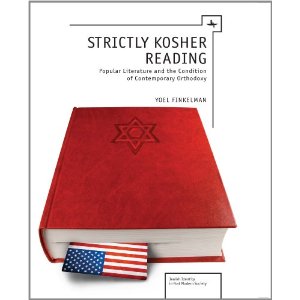 Strictly Kosher Reading: Popular Literature and the Condition of Contemporary Orthodoxy (Jewish Identity in Post Modern Society)
By: Yoel Finkelman
Academic Studies Press, 250 Pages

I have a confession to make: I, Leah Vincent, possessor of six years of university education—including a graduate degree from Harvard University—become staggeringly inarticulate when confronted by a yeshiva bochur with only an eighth grade education and an astrophysicist’s intellectual confidence.
“But the statistical probability of matan Torah is virtually impossible!” he’ll argue. And all of my knowledge of the historical record and frum ethnocentrism and advanced statistics evaporates from my head and I’m left stammering stupidly while the yeshiva bochur nods authoritatively.
My handicap may have something to do with my brain being molded into obedience by a domineering father, whom I was told never to question, or by a culture that taught me my genitals invalidated my opinion. Either way, my condition is an embarrassment. And so, it was with particular satisfaction that I read Strictly Kosher Reading. Finkelman’s book is a thorough dissection of the frum community—and specifically my community of origin, the yeshivish community—through the lens of its literature. Finkelman does many things in this clever book, the least of which are providing me with clear sound bites that I plan on using in my next battle of wits on the merits of demerits of the Charedi world.
Even readers without Debate Inferiority Complex will find Strictly Kosher Reading a worthwhile read. Dawkins, Harris, and Hitchens, for all their clarity and comprehensiveness in deconstructing religious fundamentalism, have their limits. After all, what does the average Lakewood yungaman or mother of six know about the philosophical underpinnings of their religion? What they do know, what they act from, is their culture. And Finkelman pulls apart the paradoxes and contradictions in frum culture with the thoroughness, thoughtfulness and calm cool of a pick-up stick virtuoso.
One of the major concepts he points out, is that while the frum community preaches a strict adherence to “us versus them” realities, in actuality, the frum community has become significantly acculturated into the scorned secular world.
For one example of this, Finkelman cites The Jewish Guide to Natural Nutrition, a book that frames its arguments with words from Maimonides to validate that author’s work but whose content is almost exclusively based on contemporary science.
An even more potent example is Finkelman’s evisceration of Lawrence Kelemen (which I’ll admit to relishing deeply; Kelemen was a guru-style teacher of mine in seminary, and the fawning of young women around his cult of personality always made me nauseous). Kelemen’s parenting guide, To Kindle a Soul, criticizes liberal American parenting attitudes, particularly its permissiveness, and claims to teach ancient Biblical approaches to child rearing. One would expect Kelemen’s book to therefore promote violent parenting skills, such as the passage in Mishlei: “Spare the rod, spoil the child,” or the Metzudas Dovid that says “Women who are compassionate with their children…murder them.” Instead, Kelemen concludes: “Yelling and hitting usually flips children out of the learning mode…. and into the obedience mode… which is characterized by a nervous disrupting or rebellious state.” Finkelman shows that Kelleman actually parrots the liberal American perspective he scorns: advocating for gentle, calm communication and teaching through example.
This mimicking of secular values is also apparent in philosophical works that turn to science in an attempt to validate their assertions – which leads to another bizarre contradiction: The authors “find themselves using scientific language to defend positions that the mainstream scientific community rejects. Haredi Judaism wants the prestige and authority of scientific discourse, but without accepting the conclusions that scientists themselves reach.”
Lastly, Finkelman points out the contrast between books meant for kiruv vs. those meant for insiders. Kelemen’s Permission to Believe, for example, a work clearly meant for a non-frum readership, couches its arguments to appeal to individuals searching for truth. On the other hand, a book like Rabbi Dessler’s Strive for Truth, emphasizes submission to rabbinical authority.
“A potential recruit into the Haredi community,” Finkelman writes, “is praised for his intellectual honesty…[However,] a yeshiva student who insists on his unbridled right to search for truth with rationalistic tools might not be treated with the same respect.”
Don’t we know it, Dr. Finkelman, don’t we know it.
11 Responses
This book sounds awesome, and I enjoyed the review, but “the statistical probability of matan Torah is virtually impossible!” confused me–why is your (I’m assuming) fictional yeshiva bochur arguing or stating that?
It probably means that the statistical probability of Matan Torah being a fraud is virtually impossible, as that is one of the basic kiruv arguments.
>[However,] a yeshiva student who insists on his unbridled right to search for truth with rationalistic tools might not be treated with the same respect.”
MIGHT?! A Yeshiva bochur who doesn’t accept the party line and asks uncomfortable questions is treated as a problem kid, lumped in with all the other “teens at risk:” the kids with learning disorders, the kids who have girlfriends, the druggies, and the thugs.
Thanks, Leah, for the nice review. I just want to let people know that you can download the book’s preface and read other reviews at http://www.strictlykosherreading.blogspot.com, and if you are interested in a discount copy (Amazon’s price seems to change from day to day), please be in touch with me at Yoel.Finkelman@Gmail.com.
Yoel
Wait, how does this criticize the religion itself? It doesn’t, does it? Just the culture.
I am still stumped by the mattan torah argument, and the G-d argument (something had to create the first piece of matter to cause evolution, and “the big bang” etc). But frankly I find it irrelevant . To me religion and going OTD, is a question of values ,right and wrong etc , as opposed to questions about G-d. Which is why I can see the beauty in religion and appreciate it and even live it in a certain way , and for a certain amount of time.
Can you really separate religion from culture, in terms of judging/evaluating it?
@m: Yes, because there many different cultures that all practice the Jewish religion. Chassidish, Chabad, yeshivish/centrist, Modern Orthodox, Conservative/Reform, Sephardi (from many different countries), Ethiopian, Mizrachi, Israeli dati, Israeli chiloni, and Carlebachi, just to name a few broad categories (each comprised of many subgroups). They all approach Judaism differently, even the religious ones.
Yes, some of the differences between those groups can be considered religious ones — Ashkenazi frummies, Sephardim, and Conservatives all follow slightly different sets of halachot (Reform follow none at all), but, in terms of judging a group, culture can be what makes you like or dislike a group, regardless of its level of frumkeit or machmir-ness.
For instance, Carlebachim are, on the whole, very frum, they seem welcoming and spiritual — whereas Chasidim often appear much more judgmental and insular.
why takke didn’t mohammed or yoshke claim “and three million people saw me walk on water”? wouldn’t it have made better press than “i personaly had a vision” ? and why did they both need to argue the tora is true, but nevertheless things have changed?
i’ve always wondered , according to secular historians, when did we start keeping the tora? we know when the other religions started, but i’ve never heard them say a date when they think ours started.
the whole premise of the book is false. To state that the frum community doesnt use or sets itself apart from the culture around it is simply not true. a more nuanced statement would be that it seperates itself from what it percieves to be the superficiality and superfluousness of the culture therein. Thus while they would argue with science in regards to evolution (which they feel is superfluous to the obvious direction the torah tells them), they would agree with basic medical tenets that have come about through scientific discovery. While they would disagree with fruedian psychology, they would agree to the usefulness of psychiatrists and psychologists. Basically they make a differentiation between the practical aspects of secular culture versus the theoretical or unneeded aspects. a great example would be their attitude towards internet. If you need it for business or school, then its cool, if you need it as a form of entertainment, then its not cool. Its really very simple and while it may seem contradictory to the outside world, it is actually a consistent, albeit sometimes unconscious, approach to those living on the inside.