Part of the Plan
Toeh Pastovich2011Religion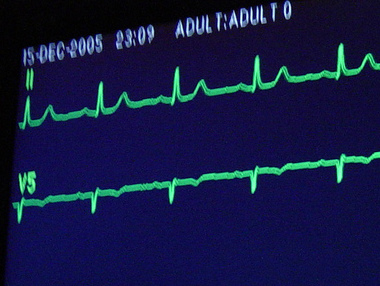 The room was dark, aside from the glow of the screens and the soft light of the bedside lamp. My brother was lying on the bed, his skin a collage of greens and browns, only a pale shadow of his once rosy cheeks remained. White foam framed his mouth, which was held open by oxygen tubes. His eyes, half open were those of a dead man. His wife was sitting in the chair beside him softly reciting psalms, which was pretty much all she did these days.
My entire family was there. Our eyes were glued to the monitor that kept track of his vitals, its glaring digits telling a brutal tale. The doctors had already told us that his days were numbered but you didn’t need to be a doctor to know that. If you saw my brother in the last week of his life, you knew that the devil had already laid his hand on him.
Then it happened. His numbers started falling like rocks bouncing down a steep decline. The alarms started buzzing. As the nurse rushed in, I swear I felt the angel of death squeeze between my sister and me and head to my brother’s bed.
My mother leaned over the bed and took my brother’s hand, then softly patted his head. Despite his age of 28, she spoke to him as if he were still the little boy she once doted on. “Tatteleh, please try to hold on.”
He then took his last breath. We screamed Sh’ma Yisroel and Hashem Hu Elokim, it was Yom Kipur and Tisha B’av rolled into one. I hugged my sister and wept in her arms like a child. My mother held my little sister and cried the silent tears of a strong and faithful woman.
“We can feel sad, but not bitter or angry; that’s for people with no aibishter,” they said, as my brother’s dead body lay nearby, still warm. “There is a Creator and this is part of His plan.” But I did feel bitter. It hurt me to see my brother suffer, and then to see and feel the anguish of losing a child and sibling.
I did not suddenly stop believing in a Supreme Being because I saw suffering in the world. My family has experienced suffering from the time of my earliest memories, so pain does not negate the existence of a God. But it did finally confirm what kind of God he is. The childrens’ ward at a cancer hospital is not necessarily a proof against an omnipotent God, but if he does exist, it serves as a testament to his character.
I have no reason to be angry with God as I don’t think He played a part in any of this. I do however feel rage when my intelligence is offended by those who say He did. What twisted mind conceived of a world where it is important to tie your left shoe before your right but it is “part of a plan” for children to die before their parents?
When I hear of the Torah being written and the Mishanyos being studied in my brother’s memory the only image that comes to mind is a feckless victim being slapped across the face and all he can do is give the other cheek.
After a tiring day of sitting shiva, despite having visited with family and friends till two in the morning, fatigue was not what I was feeling. I felt terrified. I had just witnessed the untimely death of someone I loved. The prayers offered by his family and friends and the countless others who never knew him fell on the deaf ears of an indifferent God. I was mourning the death of someone not much older than myself and I realized how vulnerable I was to nature’s wrath. I was shaking with fear and there was no God to make me feel safe and protected. I felt alone and exposed.
I fell into bed and crept beside my wife, who, sensing my pain, drew me close. She was silent as there was nothing to be said. And in her comforting embrace I realized that while we there is no Higher Power to whom we can appeal in a time of need, the love of a fellow human can sustain us just the same.
8 Responses
For Mercy has a human heart,
Pity a human face, 10
And Love, the human form divine,
And Peace, the human dress.
excerpted from The Divine Image by William Blake
May you e comforted among the mourners of Israel
I’m so deeply sorry for your loss. I lost young two brothers, mere children, in the Shoah, they perished well before I was born. My father never spoke of them unless I pestered him but their absence was palpable.
Very well written, the emotion in this story is almost palatable. Also your explanation about tragedy being a comment on gods personality, as opposed to a proof against God’s existence is a great and powerful point/feeling.
Your comfort you take from humans is important but takes a long time to reach , and I still feel alone and helpless sometimes, without a G-d to turn to.
I wouldn’t like to believe in a g-d whose every action could be explained
“The room was dark, aside from the glow of the screens and the soft light of the bedside lamp.”
thats like saying “the room was dark…except for the light”…
May you be comforted among the mourners of Zion and Jerusalem.
I say either God is omnipotent or he is benevolent; you can’t have both. Also the part about the shoes was probably created by insecure people desperately trying to structure every last detail of their lives.
Understanding and being mindful of the halachos–the ways of our G-d-centered life–shed an illuminating light. Putting on our right shoe first reminds us to give credit where due–our limbs serve us so well. Tying the left shoe reminds us to value our ‘weaker’ limb since it’s hemispheric partner, the left arm, offers itself for t’filin, a sign of our subservience to G-d and His will.
We have a beautiful compassionate Torah, both written and oral. Learning the meanings behind the rituals and then keeping them in our consciousness is the way of living a mindful life, fully awake.