Shulamith Firestone: OTD Feminist and Writer, Dead at 67
B.A. Newmark2012OpinionReflectionsReportsLove & SexOff the DerechReligion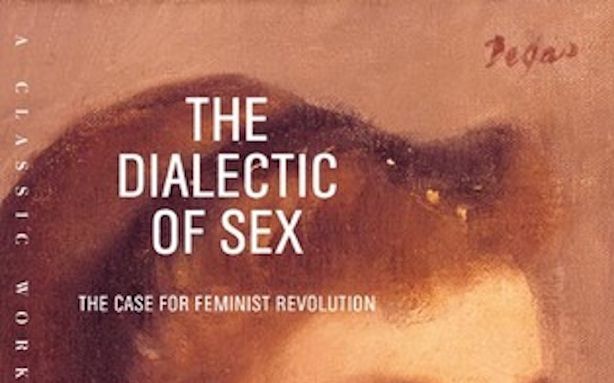 If I knew where, and if it was nearby, I would have liked to be menachem avel the Firestone mishpoche. As many know, Shulamith Firestone, author of “The Dialectic of Sex,” was found dead this week. Her neighbors had complained about a smell, and Firestone was discovered on the floor of the apartment in which she had lived alone for decades.
No doubt about it, Shulamith Firestone was brilliant, knock-your-socks-off, put-you-down-on-your-knees—and not scrubbing a floor nor sucking a cock—brilliant; crazy too, mad as a hatter. OTD for many decades, and this really was not a choice she reflected on in her writing, nor had she ever used it to define herself. She had bigger fish to fry, writing critiques of Freud and Marx and issuing often-accurate predictions on the position of women in the future.
She was about forward vision. I often did not agree with her conclusions about reproduction. Yet who could fail to recognize her project as one of the smartest and most genuine of any of her own or subsequent generations? She never turned her critical and intellectual attentions back towards where she had come from. I suspect this had more than one reason. I have little doubt that had she remained Orthodox, given her talent and brilliance, she would have been dead 30 years ago, one way or another.
Many will have noticed that most of the obituaries were careful to state that it did not seem she died of starvation—which they obviously felt important to mention given Shulamith’s history with mental illness. Her illness: a complex constellation of symptoms, which, due to the limits of language, often came down to one word. Schizophrenia. She suffered mightily for her dazzlingly creative and original mind.
I am glad that writers have pointed out that starvation (presumably, they mean anorexia) was not the cause, because the notion of anorexia has for the last 20 years become some trite model of women’s neuroses for those who can’t even imagine what Shulamith’s footsteps look like, let alone follow in them. She was not about body; she could not have cared less how she looked. No, Shulamith did not want to be skinny because she saw a picture in Vogue at sixteen and it got her “all fucked up in the head.” Which is not to say that she was not all about hunger—about always having driving hunger. But for some, hunger manifests as spiritual, others intellectual or creative.
The poet Yona Vallach said–and I translate loosely: “Everything is its thing and its opposite.” Ultimately, Shulamith did and didn’t die of starvation: intellectual, emotional, and economic. She died because she was born into a family and culture that could not medicate her properly, or even get her to eat; a culture that, had they taken advantage of every possible resource, could still not have fed her mind or her creativity—not then, not now, and in no future place she dared to define. She died completely secular, isolated by her mental illness, her gender, and her brilliance. For her, the Orthodox life was equally as crushing as the world outside of it, in which she could not hold a job; neither could offer a path to that fantastic, creative and terrible place that her mind occupied. And neither way of life values or puts much stock in the notion of hunger—a state both physical and intellectual that allows a person to constantly need. I would suggest that in this state, ideas, both political and spiritual, constantly emerge. What Shulamith understood–perhaps not by choice–is that being satisfied in life may not be the source of terribly interesting thoughts, and as a quest it is short-lived and unimaginative. And of course she had no choice. Still, what a waste to dismiss it, to not offer the respect that hunger should command.
I realize that her complete rejection of frum thought and its attendant values will make her suspect to those who call themselves “Orthodox Feminists.” Her extreme views will make her seem unpleasant and troubling to a younger generation of OTD women, who might easily dismiss her ideas as dated and irrelevant given today’s market-driven values. So yes, crazy, but at times she saw so far and accurately into the future that it leaves me breathless.
She was a product of nothing more or less than her own brilliance. There are very few people I would call “maskilim”: she was one. I imagine she would “get it” if I were to say Brauch Dayan Emes—since it is the truest thing to say because that’s how frickin’ smart and talented she was.
15 Responses
Beautiful. You’ve done her proud.
Intelligence and insight are simultaneously a wonderful gift, and a cruel curse, and the contradiction almost always results in psychological devastation.
This is especially true for women born into lives where conformity, and subjugation of personal desire, are of paramount importance
I hope she’s found peace now.
Fly free Shulamith.
I don’t get you rambling about her being orthodox and what not but as a medical practitioner I can just say she was just nuts so take it easy. There are so many people who are brilliant that I met in the psychiatric ward, but in the end they are nuts and unproductive. Schizophrenics especially become so disabled that they rarely become productive citizens even with the best treatment. Shulamith Firestone contributed to the discussion but her ideas were and still are crazy. So just because you call her brilliant she does not become so, her medical record says it best, unfortunately schizophrenia. Schizophrenics used to be in prophets in olden days. She didn’t move the world forward then or now. Today the feminists are going the same way as the communists, socialists and fascists. At some point in history Marx mattered, but as time went on he was discredited hopefully forever. I know, there will always be some rebirth but never to the extent as in the 20th century. We can say the same about the feminists. The Talmud says: since the temple was destroyed, prophecy was given to the shotim.
not enough
I did not mean to overplay her Orthodoxy, or her OTD. I wonder if brilliant and crazy are mutually exclusive–I’ll put the word out on that. I have no power to declare her brilliant–publishers and scholars did that. And she in fact “produced.” books. And no doubt she saw the world forward.
Marx does not matter? Have you been in a University class recently, read current theory or philosophy–Marx matters, really matters a lot and will keep mattering–you may just not know it.
By productive you mean not “producing” or working to help another “produce.” Ideas, insights are products. Yes some of her ideas where “crazy” but she predicted the science of reproduction quite accurately. Schizophrenia is a thought disorder which on a certain level pre-supposes “thought.” I think there should be some name for the disorder of not thinking.
Okay the temple was destroyed–and who got prophesy– lunatics, but I would listen. You have to want to listen, have an open mind to glean. BTW I am no feminist, I am a viebeleh
BA
You can be a feminist for all I care, I still don’t get this rambling about her coming from an orthodox community who somehow failed her; nobody failed her, she was nuts. She did not see “the world forward” in her rage she came up with ideas which some of them turn out to be right, pure guess no prediction. It is like the way psychics play with the fools who pay them. They say so many things wrong but people only remember the things that they want to without really asking the question was it good guess work or really something true.
When I say Marx doesn’t matter I mean the real world, not the world of academia where the abstract matters more than reality. Not to say that academia has it wrong, this is the way new ideas are produced, but it is still not reality. This is what I mean http://www.youtube.com/watch?v=YlVDGmjz7eM
Even in the real world sometimes lofty ideas can take a hold until somebody comes and knocks some sense into the people. like this http://www.youtube.com/watch?v=p7rvupKipmY&feature=related
I honestly do not see where I go on an on about her being Orthodox–I state she was raised Orthodox and her family by and large remains so. That is standard for an Obit. Why is this a problem or an overstatement. Re links: I really don’t do TV or movies and have a pretty low IQ when it comes to watching–movies tor TV shows. When I run across them I have to ask my husband–what’s going on. Although I watch many music Y Tubes music video. Rage is when you go into your old office and shoot the boss and co-workers. Rage is not sitting and writing, rewriting and editing. Nobody needs to rely on memory for what she said it can be found in most libraries.
The academy is not the “real world.” Why not because you are not there? The real world to me is any place people live and think. I equally loath the comment oh, Lakewood, Williamsburg, whatever is not “the real world.” Not for you or me to say anyones reality. So please lose the arrogance that allows you to think you have cornered the market on reality– it is unearned and undeserved.
Curios what people’s thoughts on Helene Aylon are? I’m halfway through her book/bio “Whatever is Contained Must Be Released” (though it’s really more of an art book than yet another OTD memoir) and while I do appreciate her feminist-based art and poetry, some of it feels a bit heavy-handed to me. She’s another OTD self-labeled feminist that worked with Rothko for a bit, and her series “The G-D Project” incorporates a lot of Judaic/Talmudic imagery. I do have to say I enjoy her poem “The Women’s Section,” but some of the other works feel a bit exhaustive. Just looking for some other input or opinions here. Her site:
http://www.heleneaylon.com/index.html
Also, I’m fairly certain everyone reading this site will have seen this article “Orthodox and Anorexic” on Tablet, but I figured I’d link it here just in case:
http://www.tabletmag.com/jewish-life-and-religion/109958/orthodox-and-anorexic
I don’t know much about her except by the time she had anything to do with Rothko he was imitating himself–interesting article about what happens to artists and writers after they hit–Rothko mentioned, Kafka, Mann–written by Robert Cohen and appeared in The Believer some years back, called “going to the tigers.” As best as I can tell she is very imative of what was called The Yiddish 10–included Rothko (although he tried to distance himself from them–long story and in part did have to with money), Shulem Akerman, Chaim Gross and in Boston David Aronson–they did what she did 30 years before her. Aronson the most obvious. You really do not want to know what I thought of the Tablet piece on Anorexia–whatever, they were polite. That’s the best I can say–but you know me–not very diplomatic–bowing out politely. So proud of myself.
I object strongly to the characterization of Shulamith Firestone as “nuts.” Not only does it diminish and stereotype her and her terrible disease, it reveals a hostility on the part of the writer. He uses that term like a bludgeon, and there is indeed a brutality to the whole post.
Question: Does her work reference Aldous Huxley’s Brave New World? (as far as reproduction outside the womb)
OK then. I remained curious, so I had to look it up. The answer to my question seems to be no. But, Elaine Hoffman Baruch did address the Brave New World/Dialectic of Sex contrast in her book Women, Love and Power, page 194.
http://books.google.com/books?id=aKoA2er7fkYC&pg=PA194&lpg=PA194&ots=toPcHiurGL&dq=shulamith+huxley&output=html_text
Now we can all go to sleep. Oh yeah, I just mean I can go to sleep. Good night!
This may be hard for you to understand, but non-Orthodox people also have Schizophrenia. Their families try to find them help. Sometimes it works. Sometimes it does not.
Also I think she left her family before she became Schizophrenic. Maybe if she would have stayed with her family she would have gotten better.
I wonder if she was suffering from these delusions while she wrote her books. That would be sad that Feminist Scholars would spend time studying such drivel.
One last thought. Does anyone take into account how many young women decided to follow her ideas and not have children. Only to grow up alone, over 40 and lonely. To abandon the greatest gift a woman can have: a child for some silly feminist reasons.
How sad.
Do you also dismiss Van Gogh, as the rantings of an unhinged mind. Kay Jameson has a book on madness and genius. I in part agree– Some women may have made choices to not become a mother. It is not a choice I would make but in all honesty a woman’s fertility runs from 13-37 (that’s conservative) span. So women have ample time to change their minds and reposition themselves. Many social and cultural factors led some women to not have children. It does seem to be a sad choice (to me) that I hope they do not regret but I can’t assume they would be sad just because I would be.
I’m 47 and single without kids by choice–and I’m living a very happy life. I never heard of Firestone until now, so I’m not following her advice; I’m doing what I know is right for me. There is nothing sad or lonely about it. I live a very full life as a writer and actress surrounded by friends and family. Please keep your 19th century judgments to yourself. Not everyone has to reproduce. This planet is already overpopulated with 7 billion people and counting. Those of us who choose not to have kids have more freedom to help those who are less fortunate, including the very poor and kids who don’t have parents.
I met Shulamith when she came to work at MIT in 1976. She was smart, articulate and very pleasant. She was a typist for our program for a short time, probably just the summer. I never saw any evidence that she was strange, crazy or anything but “normal.” I think she was about 31 when she worked for us. She didn’t want to talk about her famous book or her days of activism. She just wanted a job and we provided her with work. We all knew who she was and that she was “famous,” but we all tried to be respectful and just treat her as any other person. I liked her, but our paths rarely crossed beyond a few conversations. She was an excellent typist. If she became mentally ill, it was after 1976. RIP Shulamith
Rachel — That’s fascinating! Thank you for sharing that. I read this just yesterday in the New Yorker’s recent piece on Firestone by Susan Faludi:
I take it from your comment that the “unrecognized” bit isn’t so accurate.
That entire article, btw, is really worth reading, especially for OTDs and other Unpious readers. Has a lot of interesting info about her relationship with Judaism and her Orthodox family and her journey away from it all. All in all, both inspiring and heartbreaking.
Check it out here: Death of a Revolutionary