A Raizel by Any Other Name
Shulem Deen2013First PersonReflectionsReportsOff the DerechEditor’s note: This essay first appeared in TribeVibe on August 3, 2011. Since TribeVibe is no longer operational, we republish this essay here for your reading pleasure.
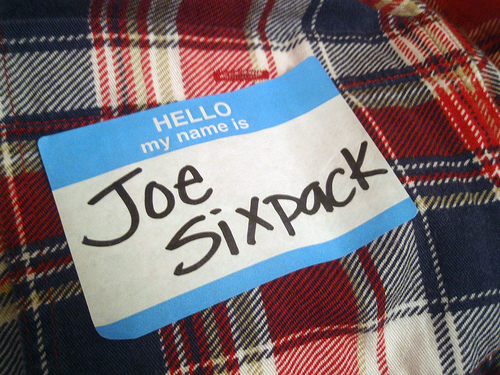
“Sean?!” my mother asked. “That’s what you go by now?”
She’d seen a comment on my Facebook page, in which a friend addressed me with a name so utterly foreign she thought it must be a mistake. When I explained, somewhat bashfully, that it was a name I sometimes used among friends, she couldn’t hide her disdain.
“Couldn’t you at least choose a Jewish name? Like Joshua? Or Jonathan?”
But that was the whole point. I didn’t want a nice Jewish name. I wanted something bland, something neutral, something that made no statement at all.
When I chose at age thirty-three to break from the Hasidic world in which I was raised, it seemed natural to make a slight name adjustment. Shulem comes from Shalom, Hebrew for “peace,” but has a particularly Yiddish inflection. It felt odd to present myself to the secular world with a moniker so provincial. Unlike some popular Hasidic names that have natural English counterparts – Yossi, Yanky, or Rivky, for example, are commonly replaced with Joe, Jake, and Rebecca – Shulem doesn’t have a secular variant. Instead, I began to use the more modern-sounding Shalom, the same word people use as a greeting on the streets of Tel Aviv or Haifa (or, for that matter, at real estate offices in Crown Heights).
Something about Shalom, however, still didn’t jibe with the ethnically neutral persona I sought. For so many years, I’d wandered through New York City in my Hasidic garb, feeling hopelessly alien to the surrounding population. Now, wanting only to blend in, it felt as if only my name stood in the way. From middle-aged Irish Catholics in Brooklyn dive bars to homeless black guys on the streets of Manhattan, my new name seemed everyone’s favorite way to demonstrate familiarity with Judaism. “Shalom!” they’d say cheerfully after an introduction, as if to say, “Yes, I know that word!” All I could do was nod politely and wish I were named Brad.
Until I took a vacation one summer in Bar Harbor, Maine. Mainians were less familiar with Shalom than New Yorkers, and with startling frequency, whenever I gave my name – usually mumbled under my breath – I got the lifted eyebrow: “Sean?”
Sean. Now there was a name I could try on. And by the time I returned to New York, I’d made my decision: I would be Sean.
“Oh my God, you too?!” a friend asked when she first heard my new name. She’s a secular Jew who finds the whole name-change thing slightly ridiculous. Other friends who transitioned from the ultra-Orthodox world to the secular also expressed the need to discard all outward remnants of their former Hasidic lives. Marc was once Moishy. Naftuly now goes by Nick. Izzy used to be Yisruel Avrum.
My friend Ryan, a former Satmar Hasid from Williamsburg, used to go by Lazer, from the biblical Eliezer, but switched several years ago in an attempt to blend in with the outside world. Along with his name change, he methodically studied secular culture. On occasion, though, his upbringing resurfaces, as when I recently spoke to him about his choice to use the name Ryan.
“What was the problem with Lazer?” I asked.
“I felt like I was a character in…what’s that movie? You know, with that famous Jewish comedian?”
“Jackie Mason?”
“No. That guy from the 70′s and 80’s.”
“Rodney Dangerfield?”
“No. The one with that girl in it–Annie something.”
Of course. The memorable scene in “Annie Hall” in which Woody Allen’s character turns, for a brief cinematic moment, into a New York Hasid as his girlfriend’s non-Jewish grandmother appraises – in his mind, at least – his Jewishness. If Ryan had trouble recalling the name of one of the most iconic film directors of the last several decades, it only shows the degree to which he’s been separated from popular culture. It is no surprise that his own name could foster insecurities about his place in the secular world.
“In my mind,” Ryan said, “the name Lazer gave me a beard and payess and a big black hat.” Payess are the sidecurls that Hasidic men grow from their temples, an adaptation of the biblical commandment in Leviticus not to cut around the edges of one’s head. Today, sidecurls are one of the most distinctive features of a Hasid’s appearance, the corporeal vestige of a sacred tradition and a mark of cultural identity.
Unlike Ryan, Luzer (not to be confused with Lazer) Twersky, the scion of a prominent rabbinic family, still wears his payess proudly, even though he long ago discarded most tenets of the Hasidic lifestyle. Luzer chomps down on pork ribs without hesitation, has had a non-Jewish girlfriend for several years, and works as an aspiring actor, writer, and consultant. As part of a personal branding strategy, he kept his beard and sidecurls and even wears his old Hasidic garb from time to time, in an effort to stand out in the competitive entertainment industry. Luzer’s unabashed pride in his background has landed him small parts in such shows as HBO’s How to Make it in America and CBS’s The Good Wife.
And his name, pronounced “loser,” has served him well too: “It’s a conversation starter. But I do have a friend who calls me Lou,” he admits. And with a kind of showbiz flair, he raises an index finger. “The thing with Lou is that it’s not Luzer, but it has ‘loser’ written all over it. Luzer works for me.”
However, Luzer is an exception to the rule. Another ex-Hasidic actor, Melissa Weiss, who plays the title role in Eve Annenberg’s “Romeo and Juliet in Yiddish,” was known as Malky for most of her life. When she first left the Hasidic community, her name led to so many questions that it grew tiring.
After striking up a conversation with Weiss, a woman on the subway asked for her name. “The minute I said ‘Malky’ she got curious. ‘Is that Hebrew? Are you Israeli? So are you still religious? And what does your family say?’ Why would I want to give all those personal details to a total stranger?”
Now, after several years, she’s more comfortable with her old name. “I’m mostly Melissa now, and I feel like a typical American girl. But if someone calls me Malky, I don’t mind. And the occasional question about my life no longer bothers me.”
As for me, after a while Sean felt lame. Adopting a secular name was like a fun, new Purim costume, which is kind of neat at first, but then your face begins to sweat under the rubber mask, your body itches from the scratchy material, you gaze at yourself in the mirror and, suddenly, it all looks downright tacky. So when I decided to switch back to my Jewish name, I went all the way back to Shulem.
In some ways, the Sean experiment was necessary. I tried it on, looked at myself in the mirror, and put it back on the shelf. Perhaps my decision to return to Shulem has something to do with the fact that, observant or not, I’ll always have a bit of Hasid in me. No matter my ambivalence about the past, the Hasidic world is a part of my identity that has informed my religious and secular lives holistically. While I may have tried on names deviating from my ultra-Orthodox upbringing, I would not readily discard its influences: an affinity for community and broadly defined spirituality… and a hankering for my mother’s potato kugel every now and then.
14 Responses
The site counted 15 responses; 14 survive in the archived copies.
shelo shini as shemom
A lot of us liberal Jews have grandparents or great-grandparents who did the same name switch from Yiddish to English when they arrived in America or entered American schools.
Grandma Molly was a Malka
Grandpa Joe was a Yonach
Great-Grandpa Louis was a Lazer
Imagine you interviewed a flower. Ask it when it was a seed what you will do when you grow up. Flower says, “I will grow, photosynthesize etc…” Every consider being a policeman or a can-opener? “No, I am a flower”.
Go to the sun. Ask it if it ever considered being a can-opener. Go to a human being-a human being can also be nothing but his essence. You can choose to be your essence-to be a man, to fulfill the Torah or deny your essence and be a self or part dead,or part of a man but you won’t be something else. You can’t change your essence but you can deny it.
Humans are unique because they do not have the ability to be another essence but only to deny their essence. We can self destruct or affirm. The greatest height you can reach is your essence. I serve G-d because I am a “I Serve G-d”.
Its much more than good kugel.
Geddy’s rabbi — Thanks for commenting. It’s sad, however, that such meaningless drivel passes in some circles for thoughtful commentary.
very true i considered it a huge thing when i started telling people my “real” name its like i came back into my self….one thing ill never get though….dos it take away from my humanness if im called something else??!?! sick of the BS..
A jewish soul in a body is like a Rolls-Royce engine in an egg beater. It is impossible that we were given this equipment to become more refined hunters and gatherers striving for more and more refined ways of eating and defecating.
It is quite interesting how the author of this article imagines that changing his name to a generic regular guy name will give him an expansion of being.
It may be an unpopular concept but in truth limitation can actually be expanding.
Once I was in a taxi in Israel and the driver saw that I was a religious guy and so he started prodding me saying, “Look at all these beautiful girls. Why don’t you look at them?”. So I answered, “Of course I think they are beautiful but I know that if I look at them I won’t be able to think of anything else and there are so many things I want to think about”. A few minutes later the taxi driver looked at me and said “You know, you’re right”.
No restrictions equals no sensitivities. A ballet dancer stretches until it hurts. Olympic athletes restrict themselves while training so that they can perform at their best.
[…] as perfect as to be called hashgocha pratis, Shulem Deen recently re-published and article called A Raizel By Any Other Name. In it, he speaks about the path to returning to his birth name, trying out others along the way […]
@geddys rabbi , taxi story creepy
Don’t understand why Jews are so ashamed of their Jewish names. My Italian-American friends go by their Italian names, same w African American friends. Taneesha is proud to be Taneesha, Giacomo is proud to be just that…but Jewish friends, Jewish friends name their kids Taylor or Cassidy or Sean because G-D forbid there should be some cultural pride. So sad.
I used to be Yaacov, now I’m Jake.
This works both ways! I grew up as Alan, but by age 30 became Avrohom. That was thirty-six (zweimal-chai) years ago. (So came the payos, the shtreimel and the white socks, too – but so, also, my professional life remains intact as well – I’m a musician [composer]). Finding the balance is next to impossible – but, it took every second of those 36 years to do it, and, in this sense, I couldn’t be happier. Hatzlocha rabba to all, whichever way you go.
M, you are only going to have cultural pride if given something to be proud about. If being Jewish is one big guilt trip, you are not going to have pride. Or if it’s based on cholent, you are also not likely to have pride.
These types of articles always make me think “this person must have gone through so much pain his entire life to cause him to be so obsessed with this stuff”. I am sensitive to that. But I cant help feeling frustrated by these articles. I feel like, move on, don’t let your whole life revolve around something that bothers you. Orthodox Judiasm works for hundreds of thousands of people. Obviously some percentage of the community will not be good, and people will get hurt because of them. Those hurt people, I cant expect them to continue to embrace Judaism, and the natural thing is for them to strike out against it. And it is important for the bad people to be outed. But it’s still sad to see the person make his life revolve around tearing down the entire religion. Understandable but sad. I believe most of todays leadership is weak, but I don’t believe most of them are malicious. These people try constantly to paint the religion as malicious, intentionally trying to ruin peoples lives. It’s not. They personally were hurt, but not because the religion was looking to hurt them.
I read the article thoroughly and I feel sad. Again.
I deal with children and people at risk my whole life. I know very well what is it that caused them to drop the life of religion.
I feel sad because I know that we, the orthodox people, and especially the parents of those souls that chose to leave – caused this sad transition.
If we’d all raise our children and treat others with more respect and acceptance, with more love and caring and without trying to force them into things – we would have happier children and adults. They will not have the need to search and choose a different path to their lives.
I did something a little different. I changed over much of my mindset and my associations but stayed observant. So I have gentile friends. I don’t dress in black and white, but with colors, etc. I don’t utter the word ‘Jewish’ every 10 seconds. The world is also my community, that sort of thing. I do my own thing, think for myself, form my own opinions, but keep mitzvot.