God’s Victory
Toeh Pastovich2013EssaysFirst PersonReflectionsTopicsReligion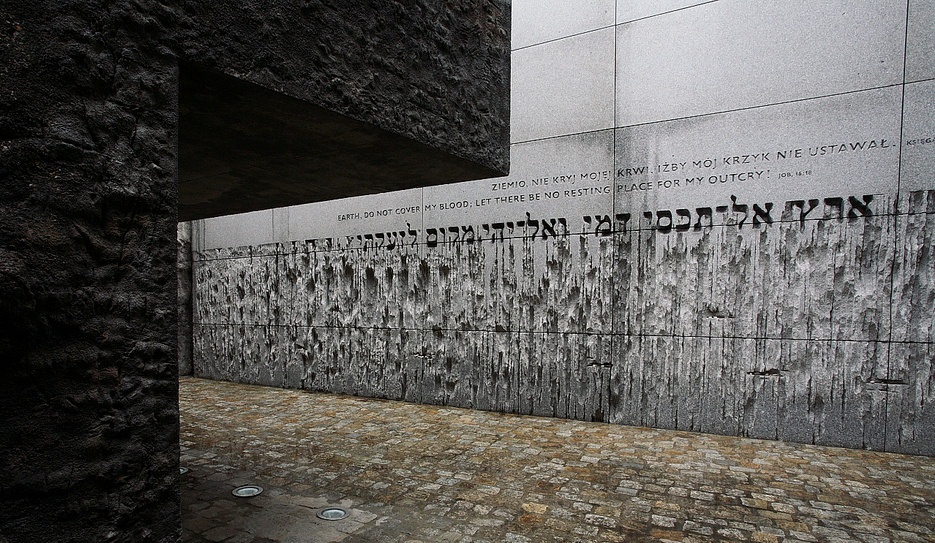
“It doesn’t seem to me that this fantastically marvelous universe, this tremendous range of time and space… this [whole] complicated thing, can merely be a stage so that God can watch human beings struggle for good and evil…. The stage is too big for the drama.”
—Richard P. Feynman
Years ago, I staffed a trip for teenage Hebrew school students through the concentration camps of Poland. Of all the sites we visited, I most vividly recall Belzec, a camp designed for the execution of Operation Reinhard, the systematic murder of Polish Jewry.
At Auschwitz you are struck by the enormity of the site, the construction of such a vast space of terror is frightening in itself. At Belzec, you are struck by the smallness of it. They had no need for extensive barracks, as the Jews, regardless of their health or strength, were taken from the trains directly to the ovens. The camp was designed not to inter but to kill.
When the Nazis destroyed the camp after the Allies turned the tide of the war, they tried to destroy the evidence, and so they exhumed the bodies from the mass graves. It took six months to finish burning all the remains, during which the residents of the town—a stone’s throw from the death camp—had to continually clean their windows from the ash and body parts that were blown there by the fire and wind.
Like other such groups, we were joined by a survivor, Inna, who lived in the New York area where most of our group was from. Inna was a pleasant woman in her 80s, with a sparkle in her eye and an understated elegance; her hair was always neatly coiffed and her dress, immaculate. Despite this being her first visit back to Poland after the war, she remained remarkably composed, even when visiting sites of gruesome torture or while retelling her worst memories. She shed only a few dignified tears at the gates of Birkenau. She asked us not to think of the dead through the suffering they must have endured, but to frame our imaginations with the cheery images of her childhood, which she graciously shared with us.
Inna knew that her married sister and family were killed, but until this trip, she was never certain where and when. It was at Belzec, with our group, when she came face to face with the facts of their demise.
I had been making my way down a walkway between two rising gray walls to the center of the memorial when I heard the unsettling sound of a crying adult—not the soft, subdued snuffles one hears at a funeral, but uncontrollable sobbing peppered with groans of pain. Inna had been walking along a memorial walkway off to the side, when she noticed, among a list of cities and towns, the name of sister’s hometown, written in rusty copper that looked like blood spread over concrete. It was only then that she lost her composure and wept bitterly. On the verge of collapse, she could walk only with the support of two teenagers from our group. As Inna descended the steps to the center of the memorial, she spoke the names of her relatives one by one: her sister, her brother in-law, her niece, her nephew. We cried with her. Inna’s face showed a kind of agony and hopelessness I had never before encountered. For a brief moment I thought I glimpsed that part of an injured soul that never heals, the wound that never closes.
I asked Inna if she would like for someone to say Eil Maleh Rachamim and kaddish, which I then proceeded to do. The students were quite shaken by what had occurred, and were worried that maybe we caused her unnecessary pain by bringing her here. She was grateful, though. We had given her family the funeral they never had, inadequate as it was.
Earlier that day, when we boarded the bus, one of the boys, a friendly kid with a sharp tongue and a knack for agitation, asked me rather rudely and loudly, why I believed in God. The dreary, gray Polish countryside seemed a great setting for contemplating the truths of the universe and soon we were having a long and thoughtful discussion about faith, science, and the nature of evil. It must have been a question on other people’s minds as well, including the adults in the group, none of whom, aside from myself, were religiously observant. The entire section of the bus seemed to have joined the discussion, either actively taking part or listening attentively.
As is often the case with such debates, by the end of it we each remained firmly in the positions we started in. That was fine by me; as an educator, I saw it my duty to teach what I knew about the world with honesty and integrity, and I felt that I had imparted my views as best I could. Whether my students changed their minds or not, never concerned me.
When we returned to the bus at the end of the day, I passed that boy’s seat again. His face was pale and his eyes were brimming with tears. He wore a slightly defeated expression as he sheepishly asked me if I he could put on tefillin. I helped him with the blessings and to wrap the straps around his arms, and soon there were others asking to do the same. For some it was their first time.
I was surprised, however, that I felt no sense of victory. I had a role in this boy’s turning to God and I should have been proud. This should have been my ‘no atheist in foxholes’ story: at the moment of pain and despair, even this hardened skeptic realized the truth and put on tefillin.
And yet, I felt none of that. I just felt empty and sad, even angry, and I did not know why.
As time passed and I lost more of my faith, I realized what was nagging me that day. It was the simple question: God, was this really worth it?
As humans, we seek purpose and meaning for our lives, we search for great truths and the answers to nagging questions. But somehow, when confronted with the enormity of human suffering, our answers strike us as hopelessly inadequate, even delusional.
On that day, when that non-believing boy was so moved to put on tefillin, all I could do was look up at God and say: You won, God. He now believes. Big fucking deal. Are you happy now? Is this what you wanted—all that pain, for this?
11 Responses
First of all, God did not kill a single Jew in the Holocaust- people did. While God did give people the choice to choose between good and evil, it’s not God’s fault if we choose incorrectly.
So the point isn’t “was it worth it” to have had 6 million Jews murdered (and tens of millions more killed in war), but rather: can there be anything redeeming from that loss? Can we take a man-made tragedy and make something good of it? I think these trips to Poland are exactly that: take a tragedy and give it perpetual meaning by uniting us. By putting on Tfillin, the boy was saying that he feels connected to all of us, and that’s beautiful.
Of course this only works for man-made disasters. Natural disasters are a whole other kettle of fish. But don’t go blaming God for the Holocaust. Take your anger out on men, not God, for that one…
Don’t blame God for the holocaust? Whatever happened to Lev Melachim V’sarim Biyad Hashem?
Beautifully articulated!
Eliezer Blasberg: What a ridiculously incoherent argument. But that aside, you seem very close to actually getting the point and–oops–you just missed it.
Yes, the question might be “Can there be anything redeeming from that loss?” And this writer is saying that whatever the answer, “The stage is too big for the drama.” God the impotent and benevolent should have a better way of making his points.
This is a beautiful and well written article. I love it.
Interesting quote by Feynman, thought-provoking , but ….
I agree that this stage of ours, our current Universe, seems a bit overdone for the sole purpose of providing a labaratory for testing a being with free will, but at the same time, this stage , and all its inter-connected intricacies, seems a bit too complicated to have just “happened”.
If anyone has the definitive answer, drop me a line.
How real, Toeh. Vivid even.
*Sigh*
I know that feeling, and you communicated it so well.
Thanks so much for sharing it.
“I’ve begun worshipping the sun for a number of reasons. First of all, unlike some other Gods I could mention, I can see the sun. It’s there for me every day. And the things it brings me are quite apparent all the time: heat, light, food, a lovely day. There’s no mystery, no one asks for money, I don’t have to dress up, and there’s no boring pageantry. And interestingly enough, I have found that the prayers I offer to the sun and the prayers I formerly offered to God are all answered at about the same 50-percent rate.” – George Carlin
To think one can shrink the universe small enough to decide God’s “victory” in the Holocaust measured in the minutes of the life of one fickle emotion-fueled teenager when deciding to perform a ritual is rather….pedantically sad.
Should God HAVE victories, in whatever fashion those are to be measured, I would doubt they are of the individual variety.
Perhaps God just asked “Ayekah” and simply awaits a response, and no more, while Man bumbles his way through Life trying to figure out where, exactly, he stands.
Blaming God for the state of Man while he tries to figure that out is no different than (and probably the cosmic equivalent of) a child blaming his parents for his failure to pass a test, or hit a baseball. Perhaps s/he is correct, perhaps not; the point of import is whether that child learns over time to be independent, to be a person of good standing (both meanings of the term implied), and to be a self in its own right. As so it is in the macrocosm of life as well.
Perhaps God heard your little inner voice mocking this child’s reaching for something bigger than himself in a Place full of memories and pain, and simply said “pitiful. As if I truly care about black boxes and educators being politically correct while promoting ritual observance that they themselves do not even care for. Maybe belief is not the point, maybe I never did care about what is DONE, but raising a world to See and Know, to Be and Become, to flower into what Man can ultimately be.
“The cavemen worshipping the weather god are gone, and soon, so will those who believe in a God of fairy tales and rituals. One day, you’ll find your Way back to the Garden where I have been waiting all along.
“Until then, I haven’t Won anything at all…”
“Toeh Pastovich = he who is mistaken, son of the son of the Past.”
Tzvi, exceptional comment, rare perspective. Brought tears to my eyes to read ideas that resonate to deeply and passionately in my heart. I wish more people would be able to graduate to your level of understanding. Thanks for posting! Who are you? What do you do? Can I get in touch with you? My email address is emaildovid -at- gmail.