Perfect Fruit
Joe Johnson2011Reflections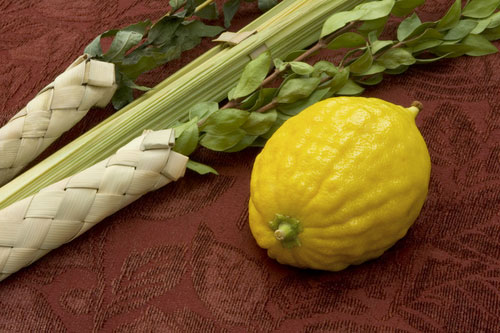 It was my first Sukkos holiday as a married man, out from under my father’s steady guidance, and, as was customary, I now had to purchase my own esrog. It was a day before Yom Kippur when I stopped by the women’s section of a neighborhood shul, now conveniently converted into an esrog shop.
It wasn’t my first time there, of course. During years past I would accompany my father, who would spend hours running around town to various esrogim merchants in order to find the perfect one. I would watch him scan the selections laid out on the tables in their styrofoam packing, occasionally convincing an esrog merchant to show him something better, knowing that almost always there were select specimens hidden away for special customers. After several days of searching and inspecting, he would finally settle on one, and he would leave the shop with the esrog tucked in its cardboard carton under his arm, his face glowing with satisfaction. “Burich Hashem!” he would say to me, his joy spilling into an impish grin. During the next few days, as the esrog lay in its carton above the large mahogany bookcase in our dining room, he would reach up for it several times during the days before yom tov, carefully remove the esrog from the box, and inspect it as one might a prized gemstone.
My father, a Talmud scholar and a teacher at one of the neighborhood’s prestigious yeshivas, spent his days studying, and his assesment of an esrog was far from that of a layman. Unlike the casual esrog buyer, my father was concerned less with an esrog’s immediate appearance – its shape and color –than its more technical aspects: cleanliness. “See this?” he would say to me as he pointed to a tiny light-brown spot over the esrog’s outer skin. “That’s nothing but a blatt fleck.” And with his fingernail, ever so carefully, he would show me how it could be removed without damaging the esrog itself. The mere remnant of a leaf that had attached itself to the esrog’s outer layer, an external blemish. “But this here,” he would frown as he pointed to a black dot, “not good. And it’s above the choitem.” He would point to the curve rising to the esrog’s peak. “Not a true huder,” he would say, and lay it gently back on the table for less discriminating shoppers. He would also assess an esrog’s size, wondering aloud about the smaller ones, whether they met with the shiur Chazon Ish, which he sought to abide by.
With every passing year, I learned more and more, until my knowledge of esrogim was almost equal to his. I would notice the tiniest dots, the ones that most people detected only with the use of a magnifying glass. I developed my own aesthetic sense for shapes, sizes, and colors; my favorites were warm yellow with a hint of green at the peak, slightly elongated instead of pear-shaped, with a subtle groove around its center – the gartel.
Now I was buying my own esrog for the first time, and my expertise would’ve served me well. Except that things had changed. I was no longer the little boy who loved the holidays, with its distinctive sights, sounds, and smells, with all its rituals and ceremonies. I was engaged these days less with adhering to religious matters as much as questioning them, assessing the behaviors of those around me and wondering about the religious extremes to which we took things. I was developing a distaste for the conformity of the masses, for those who, like an unthinking herd, questioned little and went about their daily lives guided only by how closely their actions resembled everyone else’s. Purchasing the perfect esrog was no longer a priority, and as I stepped into the boisterous cluster of esrog shoppers, I reminded myself once again that I was going to spend the least amount possible. I wanted a kosher esrog, nothing more.
Half a dozen Chasidim stood around a table at the far end of the room, bent over a spread of esrogim, each waiting for a turn at one of two magnifying glasses available. One of them held an esrog up to the bright fluorsecent light on the ceiling, then lowered it and swabbed it with a Q-tip before inspecting it again.
The sharp fragrance of fresh citron and palm fronds filled the air, and I found myself inhaling deeply, savoring the memories they brought of all the years past.
I remembered the mornings of the first day of Sukkos, when I would stir groggily on my folding cot near the wall of our wood-paneled sukkah, a breezy chill coming through the unsealed walls. The s’chach branches would rustle above my head, and through it, on occasion, a pine needle would fall through and dance through the air before resting on my blanket cover. It would be soon after dawn, and my father would already be awake, standing at the table with the old machzor in hand, from which he’d be reciting the prayers before the ritual shaking of the lulav and esrog. From the far side of the sukkah would come the sound of flowing water from the miniature waterfall my older brother had built, the words “Ush’avtem mayim b’sason,” – may you draw water with joy – etched into the wood panel behind it in gold lettering.
My father would be swaying as he recited the prayer softly, the gleaming silver adornment of his sparkling white talis draped over his shoulders, his graying beard and long payess still wet from the mikvah, his eyes closed, his countenance appearing, in the foggy haze of my still half-asleep mind, more angelic than human. I recognized that look on his face; it was the look I saw only on special events like the Pesach seder, or at one of his children’s weddings, or as he blessed us with his hands above our heads – “Yesimcha Elohim ke’efrayim vechim’nasheh” – on the eve of Yom Kippur. His eyes glistened as he held the long palm branch in his right hand, and with his left reached for the esrog, now laying in its sterling silver container in front of him.
Later, I would rise and get dressed, and after sitting at the table beside him with a slice of fresh brownie cake, which my mother had baked for the yom tov, my father would hand me the esrog and lulav to perform the ritual as he did, and he would look on with pride. I would wave it, as I’d been taught, three times in each direction — right, left, forward, up, down and back – to ward off the evil that might come from any unpredictable source.
These were the memories that came to mind as I scanned the tables for an esrog of my own. But they were from a time of youthful innocence, and they were now mixed with other sentiments. I don’t quite know when it happened, but at some point during those years I lost my passion for religion in general and chasidus in particular. On the one hand I still cherished the traditions with which I was raised, but on the other I saw hypocrisy and pettiness hidden under our long coats and black hats, the smug and haughty posture of self-righteousness. Faith, instead of being a vehicle for self-reflection, seemed now only an excuse for ignorance, for heaping scorn on those who dared to be different, for vilifying those with the courage to ask difficult questions.
But now, like with many things that remain indelibly etched in our psyches – favorite songs and foods and family events – I wished for the chance to relive old experiences. Once again I felt an affinity for my Chasidic roots, for the moments of genuine warmth that I had to admit do exist, for old favorite niggunim, for the uniquely Chasidic attitude of simcha shel mitzvah. I felt a rush of warm feeling for my fellow Chasidim, who, despite my disagreements with their worldview, possessed that which had once imbued my life with so much meaning.
“Buying an esrog before Yom Kippur,” I now heard someone say, “is a good way to be zoiche b’din.” I hadn’t caught the attribution. Did he say it was the Tzanzer Ruv who said it? Or was it the Choizeh of Lublin? Or perhaps the Rupshitzer? I glanced at my watch. My wife would be waiting, and it was already late, and I began to inspect the esrogim, still thinking to make a hasty and inexpensive choice and be done with it.
But the first esrog that I picked up had a black dot an inch from the peak, almost imperceptible, but I knew my father wouldn’t have taken it. I picked up another, but it wasn’t shaped the way I liked them. I’ll check just a few more, I thought, and before I knew it, an hour had passed, and I was still reaching, inspecting, then reaching for another, force of habit pushing me along to look for just one more, just to experience the joy of finding that perfect one. I wouldn’t buy it, but did it hurt to look?
Eventually I found it, the perfect specimen, shape, size and color coming together to form one of the most pleasing esrogim I ever held. I ran my finger over the bumpy exterior, then put it back in its carton. But something drew me back, and after inspecting several more esrogim, I came back to that perfect one. The esrog dealer now hovered nearby, replacing misplaced esrogim into their styrofoam nests, and organizing the cartons in orderly rows. Unable to resist, I looked in his direction and his eye met mine as I raised an inquiring eyebrow. I had to know the price.
Walking home with my newly purchased esrog in hand, I thought of all our other yom tov expenses that month. The thousand dollars or so we’d spent on a new sukkah, the several hundred dollars that I spent for my wife’s gift for yom tov - a new bracelet, and the cost of the many boxes of groceries delivered from the supermarket. The cost of the esrog wasn’t quite a trifle. But it was the most perfect esrog I’d ever held, and it was the most satisfying 175 dollars I’d spent all month.
7 Responses
nice piece- I sense your nostalgia- and teh vivid imagery is beautiful. I cant wait for all the skeptics to start mocking the esrog concept …..
Great piece. The story really drew me in.
Lissa — Saul Lieberman was once said to have introduced a lecture by Gershom Scholem, the great scholar of Kabbalah, with the following: “Nonsense is nonsense, but the history of nonsense is still scholarship.”
So too, the concept of esrog is worthy of mockery. But our personal histories with the esrog (as well as our other cherished traditions) still make for good stories.
This comment is well liked. Like it too?
Joe – I LOVE IT! Passion for esthetics, appreciation of beauty and excellence, and attention to detail were so deeply ingrained you could not suffer a lesser specimen. And that is exactly what the concept of esrog, the “Pri Etz Hadar”, represents; those are attributes this mitzvah should plant in our souls.
Moving, captivating writing, and a refreshing perspective here. More strength to you, my friend.
I love this piece if writing. Very emotional and uplifting!
I think this piece brings out quite an important part of unpiousness. Even after all the pain, skepticism, and struggle, Many Unpious people still retain some sort of connection and love for chassidus or at least parts of the chassidic lifestyle etc, which makes it that much harder and complex.
Hi there,
so nice to be with you again, sharing another part of my life with my fellow unpious people, those who are, or were with me in the same boat. I believe that it’s very important for all of us who are still in the system to focus on the good parts of the community – pretty hard to find, but quite satisfying when you succeed. This is what keeps me going, and I consider it as the only way of surviving.
Thanks so much for everyone who took the time to give positive feedback, I really appreciate it, and it gives me the courage to write more in the future.
joe
Feel free to share any thoughts at joejohnson752@gmail.com
This comment is well liked. Like it too?