“My Name is Asher Lev”: The Pain and Passion of a Young Hasidic Artist
Sara Trappler-Spielman2013Arts & CultureTheatreOpinionNews & MediaFamilyOff the DerechReligion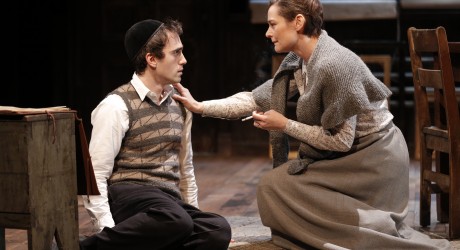 For a Chasidic boy living in the shadows of a post-holocaust world, where everyone around him is consumed with rebuilding lost worlds and holding fast to straining traditions, Asher Lev is an unusual child. He seems aware of only two things: an un-pretty, painful world and a burning need to draw.
“My Name is Asher Lev,” a new play by Aaron Posner based on Chaim Potok’s novel of the same title, gives us that world in an intense and emotionally charged plot that will captivate anyone who has ever had to endure the messiness of childhood and adolescence or to have struggled with self-expression or existential angst.
The play will strike even deeper chords with anyone caught between authoritarian social structures and the irrepressible urge to carve out an identity of one’s own; community expectations set against personal freedoms; the guidance of a rebbe or parent set against one’s own burning desire to heed one’s own passions.
Ari Brand, who plays Asher Lev in the off-Broadway run of “My Name is Asher Lev” at the Westside Theatre, begins his well-acted 90-minute dramatic journey by facing the audience and saying, “I am a traitor, a self-hater and blasphemous Jew.”
Asher is a gifted young artist who feels compelled — almost without choice — to paint. The trouble surrounds the type of art he draws, first as a youngster who visits art museums in secret and then later as an apprentice to a successful artist in Manhattan. His drawings of “naked women” and “crucifixions” don’t go over well with his Chasidic father, who spends his life trying to rebuild yeshivas and Torah centers for Soviet Jewish refugees in Europe.
Considered a “pagan in my own home,” Asher Lev is told by his father, Aryeh (Mark Nelson, who plays other male roles in the production), from a young age that his “pictures are disgusting, foolishness, and narishkeit.” Later in the play they hash out the point of these drawings, with Asher arguing the difference between a nude painting and a naked woman – a nude being the interpretation of the artist’s view of the body. The bottom line, Asher explains, is that in order to be a real artist, you have to draw from these most crucial subjects of the tradition. His mother, Rivkeh (Jenny Bacon, also playing other female roles) laughs, turns to her husband and says, “It’s tradition.”
It is his mother who serves as a buffer between Asher’s need to paint and his father’s disapproval, and it is his mother’s pain that soon becomes part of Asher’s artistic compulsion. When her brother, Asher’s warm and loving Uncle Yaakov, dies in an automobile accident, Asher’s mother is never the same. In an attempt to make her happy, he draws the world pretty — birds and flowers — but he hates them because he feels they are lies. So he then draws his mother’s screams, her silence and cigarette smoke.
The irony is that Asher’s art becomes the cause of so much anguish and suffering. Whether it is his ultimate salvation or destruction depends on what side of the coin you are on. His art brings him closer to an emotionally rich and complex world. At the same time, it distances him from the community and his rebbe, the worlds in which he is anchored physically and spiritually.
Asher Lev thinks he might be able to choose both, but he is quickly disabused of that notion. “Art is not for people who want to make the world holy,” says his ex-Chasidic art teacher, Jacob Kahn, a now-famous painter who was introduced to him by the rebbe himself. “You enter a religion called painting, a tradition of goyim and pagans.”
The thirteen year old Asher, a “prodigy in payos,” can’t help but choose art. He still remains observant, but no longer fully part of the observant world. The distance between him and his religious community can best be compared to the bridge he crosses from Brooklyn to Manhattan, where he begins to sell his art at sold-out solo shows on Madison Avenue. The distance is short, yet far, returnable at any moment and yet one never returns the same.
One wonders whether Asher’s choice is a fully realized ambition or a life that remains in constant tension, seeking reconciliation between the worlds of art and the traditions that stand opposed to it. Earlier in the play, we see glimpses of that elusive bridge in the character of Asher’s mother, Rivkeh. Torn between her stubborn, yet sensitive and passionate, son and her rigid, austere husband, Rivkeh urges her son to show respect to his father nonetheless.
“I have no idea how to talk to him,” Asher shouts.
It is a shout almost as primal as the screams he paints of his mother. It is as if he wants the reconciliation between himself and his father, between his passions and his traditions, but the formula for achieving it eludes him. His world is expressed in art, not words, and so he and his father do not share a language in which they might find hope for understanding.
It is so between Asher and his father, and it is so between Asher and his community. It is, furthermore, the same timeless challenge facing all who stray from community and tradition to follow their own trajectories of purpose. As if it is merely a failure of language — “I have no idea how to talk to him” — that creates this tension, this unbridgeable chasm between those who leave and those who remain.
Yet Asher will say, as he does at the end of the play, that in art, he ultimately does find that elusive bridge. Although his parents may see it as a force for destruction, for the artist it is his salvation. “My art is from the Sitra Achra and Riboneh Shel Olem. It has the power to hurt and to heal.”
“My Name is Asher Lev” runs through May 26, 2013 at the Westside Theatre, 407 W. 43rd St. http://www.asherlevtheplay.com
5 Responses
without even reading the review, i can’t help but dismiss outright anything written by potek as propaganda and irrelevant, his writing has always had such an angry feel to it making it personally unreadable to me. in addition it shows such an obvious misunderstanding of chassidishe culture and a lack of an insiders knowledge so inherently important to the experience. even with all that said, from a pure literary perspective his characters are one dimensional never fully realizing the true human form (i.e. the father figure)making them and the story neither plausible nor particularly satisfying. it is a shame that he has come to represent the experience, i would love something that could represent it in all its richness, the good the bad and the sometimes ugly.
@ Chaim “without even reading the review, i can’t help but dismiss outright anything written by potek as propaganda”
Wow, what an accusation. As an in-between chassid and one who is truly OTD to the family I found a lot of joy and pain in all of Potek’s work. I wish you could see the same…good luck.
@yosef the comment had nothing to do with frumkeit and or yiddishkeit. it has to do with his inherent dishonesty and frankly poor literary and character development skills. i can understand the appeal of his message (im otd btw as well) but for the life of me i can’t understand the draw to his writing, it reeks with hate.
@chaim: Most readers of Potok are likely to disagree with your assessment of his “poor literary and character development skills,” but that’s a matter of taste, so you have yours. Fine. But can you cite any actual examples for Potok’s “dishonesty”? That’s something we can analyze pretty objectively. If you can’t, you’re talking out of your ass.
> i can’t understand the draw to his writing, it reeks with hate.
This gives you away. You seem to have a bone to pick with him about matters that pertain nothing at all to his literary skill.
@hesky once again people, don’t get all up in arms and don’t misinterpret my dislike for potok as something or anything to do with religiosity. you can very strongly agree with a message and disagree with the messenger. his characters are simply flat and never develop beyond caricatures. i.e asher the seeking son, his mother the caring and also abused mate and most of all the father the religous lunatic. when you as a writer refuse to nuance and veer from the obvious stereotypes its not only lacking in credibility it is boring. the sign of a great writer is adding the detail and not distracting from the message (if messages are to begin with an objective). there are plenty of writers from shalom aleichem through roth who essentially give the message without distilling from the story and or basic humanity of their characters.